Below is a written version of Pastor Jo Schonewolf and Ian Urriola’s reflection on this sixth Sunday of Easter, published on Sunday, May 17, 2020. You can view the original video below.
Jo: Would you pray with us?
God of all things, known and unknown, thank you for gathering us together. Make your presence known among us. And may the words of our mouths and the meditations of all our hearts be acceptable to you, our Rock and our Redeemer.
Jo: I’ve grabbed Ian for today’s message because our scripture is set in the Areopagus in Athens and Ian, you’ve actually been there, right?
[Ian describes the acropolis and the surrounding area, along with the temples, near the Areopagus.]
Jo: And was he successful?
[Ian describes the outcome of Paul’s mission]
Jo: So, other than some interesting history, what do you get out of this story about Paul’s unsuccessful visit to Mars Hill?
Ian. Well, in terms of Paul’s successfulness, there’s something to be said about seeds needing to be planted in good soil, but I actually think this story from Acts has something to teach us today about idols.
Jo: Say more.
[Ian describes the idols in the area around the Areopagus.]
Jo: Yeah. I think there’s a lot of wisdom in that. I know that I’ve heard a million sermons about casting down your idols, but people are idol-makers. It’s good for us to be mindful of the things that we have a tendency to make idols of. What sparks my imagination, what causes me to reflect in this story is, I think, the idea of an altar to an unknown god.
Ian: Yeah?
Jo: Yeah. Like, we can see the other gods that are up there, the god of strength, wisdom, war, gods of fertility and wealth, but amidst all these big gods, someone took the time to make a kind of catch-all god, a god of the leftover things. And it’s beautiful to me that Paul doesn’t choose to say: “You know the god of power and victory as Ares, but really, that’s the one true God” or “You know the god of wisdom as Athena, but all wisdom comes from my God” or “You have a temple of the Furies, but vengeance belongs to the Lord.” He could have made so many other arguments about the temples of so many other Greek gods, but instead he chooses to focus on the altar to the unknown god.
That’s beautiful to me, because how many times in our lives do we experience God in ways we didn’t expect or in ways that we wouldn’t have known unless we were looking for God? I mean, I found God in the crawlspace under the church, where I could sit on the earth below us and look at the stone foundations that to this day hold up the church, foundations laid by people with hearts bursting to build a church. I found God in changing diapers, in making clean and comfortable something that was messy and squishy, in offering help to a little human who could give me nothing in return. Heck, I found God in the possum outside our window the other day, just delighting in this little funny animal who eats ticks and doesn’t ask for anything from me.
And who in ancient Greece would have been the god of crawlspaces or dirty diapers or possums? None of the ones with temples, that’s for sure. Paul says it more pointedly in 1 Corinthians: God chooses the lowly things in this world to show us that great things mean nothing apart from God. I can’t worship Ares or Athena or any of the others. They’re just super people doing super people things and I’ve seen again and again how people fail. But an unknown god, a god of leftovers, that God I can talk to.
It makes me think too of Philippians 2, where Paul talks about Christ emptying himself in order to be with us, that Jesus didn’t consider equality with God as something to be exploited. That’s what makes this passage make sense to me and what warms my heart about it: of course, our God doesn’t need huge temples or to be served by human hands. Our God has the entirety of creation to sing out God’s glory, but instead, God is willing to be found in the altar to an unknown god. God is the God of little things as well as big things. God is powerful, sure, and all wisdom comes from God, and in the end, all things came from God and all things will go back to God, but God isn’t only found in strength or wisdom or ultimate power. God is found everywhere, in both the obvious and in the unknown places. Sometimes, it’s easier to find the unknown God.
Ian: What do you mean?
Jo: Well, you expect to find God in a church, right? That’s your known God, the God you sing alleluia to and offer prayers to. The God you get dressed up for. But sometimes, it’s hard to find God in church. Maybe the preaching doesn’t do it for you, maybe you’d prefer different music, or maybe you have to work hard to find God in the ceremony or in the sacraments. Worse, you feel a little ashamed or afraid because you’re “supposed” to find God in church. We all know that that’s where you find God.
But sometimes it’s easier when God surprises us by being in unknown places, places where we don’t expect to see God. It took me years to realize that the unknown god I felt in the planetarium was God. The unknown god of late night discussions in bars is God. The unknown god of singing Bohemian Rhapsody with forty people on the marching band bus is God. All these unknown gods, these feelings of holiness that I felt should be celebrated, but wasn’t really sure how, all those unknown gods are God, and they feel more like God than sitting in a church building sometimes does.
Ian: So God is in the unknown places?
Jo: I think God can be in the unknown places, yeah. I mean, John Wesley spent time among the poor, the sick, and those in prison, and there are scores of other theologians who will tell you that you’ll find God in places that are unknown to many Christians like us. God is in the unexpected safety of a girl who passes out at a bar and wakes up without having been hurt. God is in the narcan that gives someone dealing with addiction one more chance at life. God is in the neighborliness of the trailer park or in the busting of fire hydrants in inner city summers. God is in underfunded classrooms and along the sides of roads and everywhere an unhoused person finds a bed. God is the unknown god in these places too.
Ian: I like that. I like that God isn’t just where we expect God to be. And I think that gives us something to practice. We can practice looking for God.
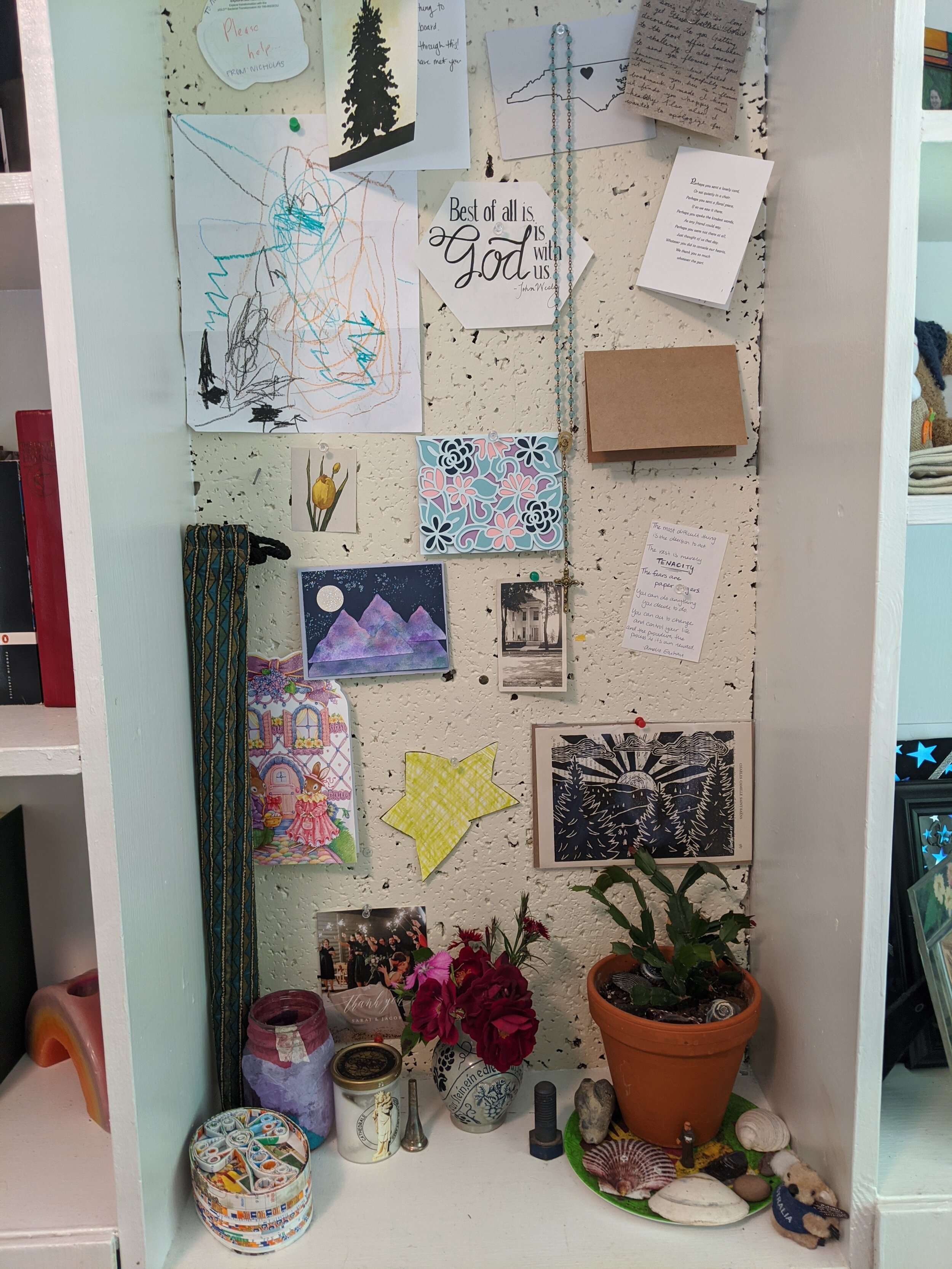
Jo: I was thinking the same thing. This passage got me thinking about what I would put on an altar to an unknown god, so that I can give praise to God even now, when there’s so much about life that feels unknown. It’s given me joy in this time, and so I invite each of you to make something like this. Find a space in your home where you can put *talks about stuff on the altar.* When we do this, if we’re doing it in the right spirit, we’re tearing down our idols, not making new ones. Doing this reminds us that our God is the unknown God, who is with us wherever we go, not just in the places we expect.