This sermon was preached at Whittier UMC on Sunday. January 12, 2020, based on Matthew 3:13-18. You can listen to it by clicking below.
Would you pray with me?
God who made us, redeemed us, and loves us deeply, thank you for bringing us to this time and this place. Be with us here today. And may the words of my mouth and the meditations of all our hearts be acceptable to you, our Rock and our Redeemer. Amen.
I have to be honest, it’s been difficult for me to be a Christian this week, and not just because Carolina lost to Clemson last night and that makes me want to use some very unchristian language. I don’t mean that it’s been difficult for me to be patient with and kind to the people I encounter, to listen with intent to the people I’m talking to, to be generous with my time and resources, or to not cuss when I shouldn’t. All those things are part of being polite and I didn’t struggle with politeness this week. No, this week I struggled with being a Christian.
I mean that I struggled with believing the things that we as Christians are supposed to believe. And it’s not that I got caught up on intellectual arguments about whether the Resurrection actually happened or whether miracles do occur—I’ve already had walked alongside many of those arguments and doubts and I’ve come to terms with them. No, this week, I struggled to believe that the church could be the hands and feet of Christ in this world. I struggled to believe that following Christ was even possible this week.
Which is quite a thing for a pastor to struggle with. I mean, out of everyone here, I’m the one who should’ve bought into this Christianity thing hook, line, and sinker, right? If there’s anyone here who should be convinced of the rightness of Christianity, the Church, even the United Methodist Church, it should be me. And yet here I am, wrestling with the very idea of being a Christian and living in Christian community with others.
I’m wrestling because it’s become harder and harder for me to see the image of Christ in our Christian denominations. It’s become harder and harder to see the Spirit moving in our denominations. More often than not when I think about what’s going on in the United Methodist Church or indeed in many other denominations, I see hearts of stone instead of hearts of flesh. The way Christianity is presented in the news, the way that we see Christians that we disagree with, it seems like the only way to be a Christian in this world is to be certain, to know the rightness of your reading of scripture, of your understanding of an issue, of the correctness of what you’ve been taught, of the righteousness of your way of thinking. I wrestled with being a Christian this week because I always wrestle with hardness of heart.
It makes sense that I would bump up against hardness of heart, of course. I’m a scientist. And scientists at their best, science at its best, is a mind-and-heart wide open endeavor, looking around the world with joy and asking questions, being intrigued by something you’ve just discovered and seeking to know more about it, to be thrilled by existence and all that it holds. Hardness of heart has no place in good science, because you always have to be open to the possibility that you’re wrong, that the way you understand something isn’t quite right. You can’t have a hard heart in science, because, at the end of the day, you’re always going to be wrong.
Take gravity, for example. Newton explained gravity to us centuries ago. We used Newtonian physics to send people to the Moon and back. But General Relativity offers a completely new way to understand gravity, a way of understanding gravity that explains why Mercury’s orbit is so odd or how galaxies hold together. And yet, General Relativity itself leaves us with questions when it come to the quantum level. The way we understand the largest things in the universe doesn’t work well with the way we understand the smallest things in the universe. And so, there’s still more to discover, more to understand. But if you’re holding on tightly to General Relativity or Newtonian physics, if you’re hardened because you think our current understanding is right, you’re never going to be able to join others on the search to discover what dark matter is or how time works or how the universe is held together. You know what? I take back what I said before. You can have a hard heart in science, but if you do, you’ll miss out on all the new things there are to learn and discover and seek to understand.
And honestly, if I’m going to be a Christian, I have to interact the same way with God. I can’t have a hard heart toward God or toward those whom God loves, because then I’m going to miss out on all there is to know and discover. I have to be open to all that the Bible has to teach me, from Genesis to Revelation, from Job to Acts, from Kings to Mark, from Exodus to 2nd Timothy. I have to be open to all of the wisdom from the past, from theologians and doctors of the church, from mystics and from pastors and from all who have tried to help us better understand God the Father and God the Son and God the Spirit. I have to keep my ears open to all today who offer an understanding of God that I might not have ever heard of before, because we know that the Spirit is moving in this world and in this time, amen? We know that God works with us still, and God speaks to us through hymns and songs and scripture and sermons and stained glass and stories and nature and strangers. If I’m going to be a Christian, a hardened heart is the last thing I can have. A hardened heart is closed off to God.
Friends, the last thing we need right now is to be closed off to God.
That’s been the core of my struggle to be a Christian this week, I think. That’s what’s been at the root of my problems. I’ve found it difficult to believe that the Church (the capital-C, Church Universal Church) is able to be open to God in this time and place. The Church is full of hardened hearts, self-protective hearts. And it’s easy to see why. The world is too frightening to be open to all that God could want to do. The world is too overwhelming to do what God calls us to do. There are too many hungry, too many thirsty, too many seeking refuge, too many without shelter and clothing, too many sick, too many imprisoned for us to see them and care for them as if they were Jesus. There are too many enemies for us to be able to love them. There are too many neighbors if, as the Parable of the Good Samaritan suggests, it is our role to be neighbors to all. There is too much war for us to be peacemakers, too much grief for us to mourn alongside all those who mourn, too many poor for us to care for, too many widows and orphans and abandoned people for us to take them all in. It is impossible to do what Jesus calls us to do. It is impossible to be a Christian in this world.
And yet.
This is the exact world that Jesus was born into.
Jesus was born into a world of hardened hearts, a world that thought it knew the way of things. Jesus was born into and lived in a world where there was a right and wrong way of being Jewish and God help you if you did it wrong. Jesus was born into a frightening world, a world where Rome could attack at any minute, at the slightest provocation or without any provocation at all. Jesus was born into a world with too many hungry and thirsty and sick and without shelter and travelling far from home and imprisoned. Jesus was born into an overwhelming world, a world full of people just trying to get by, a world full of hearts that almost had to be hardened in order to make it through the day.
We heard about Herod and his intrigue with the Wise Men last week. We heard about Herod and his desire to take out a new king at all costs the week before. We heard about Joseph, who had to have an angel come to free him from his righteousness before that. This Christmas and Epiphany season has been overshadowed by the hardness of heart of many in Jesus’ world. Each time we revisit these old stories, we have to admit that, at least in hardness of heart, Jesus’ world looks much like ours today.
And then it begins to make sense why Mary is the one who will be remembered from generation to generation. It’s her open heart, her heart that was open to God, that started it all. Mary, and then Joseph, open up their lives to God and into this world of overwhelming uncertainty, God is born. And Emmanuel, God With Us grows. And one day, the Word made Flesh hears the teachings of a man named John, a man who understands how hard-heartedness has stopped the people from hearing God, from seeing God in this world, from knowing God-with-us, a man who calls for repentance from all these things, a man who calls for cleaning yourself so that your heart might find its softness once again, Jesus hears this man John, John the Baptizer, and he goes to be cleaned himself.
Now, John, the man who’s been proclaiming this baptism, this cleansing that can lead to opening, John knows who Jesus is when he sees him. John’s heart has been softened for such a time as this. And yet, some of the hardness lingers. “You should be baptizing me,” John says. And Jesus, ever flexible, ever open to seeing people as they are, where they are, Jesus says, “We can still fulfill righteousness this way. Baptize me.”
And isn’t that just the way Jesus is? Jesus comes to us and we protest, knowing that what we do isn’t good enough, isn’t perfect enough, for God, and Jesus says anyway, “Let me do this with you.”
And where Jesus goes, God goes. After Jesus comes out of the water, the Spirit descends like a dove and a voice from the heavens says, “This is my Son, whom I love; with him I am well-pleased.”
We might think of that as a whisper, something quiet, maybe something that only Jesus could hear, an affirmation for just him, and you can read that in Matthew’s gospel, but I like how it’s described in Mark. The Greek in Mark tells us that the heavens became a voice, the sky became a voice, meaning that it seemed that from all above them there was a voice that proclaimed that Jesus is the Son, the beloved, with whom God is well-pleased, as God is always well-pleased with Godself. And I love that. I love that Jesus is loved out loud, the way I long to be loved out loud. Jesus, the Son, the Word of God who put on flesh, lives within a blessing so large that he can never step outside of it, the blessing of being a perpetual part of the Godhead. The sky thunders with this.
And here is the miracle, my friends. In our baptism, we die and are raised with Christ. We put away our old selves, our old hardened hearts, and we put on the ever-open, ever-softened heart of Christ, the child born of God and raised by Mary and Joseph to encounter the world around him with joy and excitement and wonder at existence, the God who came into our world and wants to join us in all that we do. When we were baptized, the same voice thundered, the same voice, the voice of God the three-in-one, filled the sky. “This is my child, my beloved. With them I am well pleased.” It thundered for all those with ears to hear it.
A saint, albeit a modern-day one, expressed all of this in a perfectly simple way. Fred Rogers once said, “A love of learning has a lot to do with learning that we’re loved.” Before we can soften our hearts, before we can open up ourselves to trust God, to listen to the guidance of the Spirit, to follow the way of Christ, we need to learn that we are beloved. Our hearts are hardened out of fear, but perfect love, God’s love, casts out all fear. If we can trust that we are beloved by God, that we are loved with a love so immense that we can never step outside of it, that we will forever and always be loved, then we can walk through this world with hearts that will never harden. If we know that we are beloved, we can decide what to be and go be it.
Friends, I have wrestled with being a Christian this week. I have felt like a pinball, bounced between one place of hardness to another. Maybe you have too. Or maybe you have felt God pushing against the hard places in your own heart and known that something would have to give. But I honestly and truly believe that God calls us to a place of openness, a place of joy and discovery, a place where the hardness of our hearts is broken and the dance of life abundant can begin within us, guiding us ever deeper into the mysteries of the belovedness of all creation. Where the Spirit of the Lord is, where belovedness is, there is freedom. And I believe that God is calling us to that freedom today.
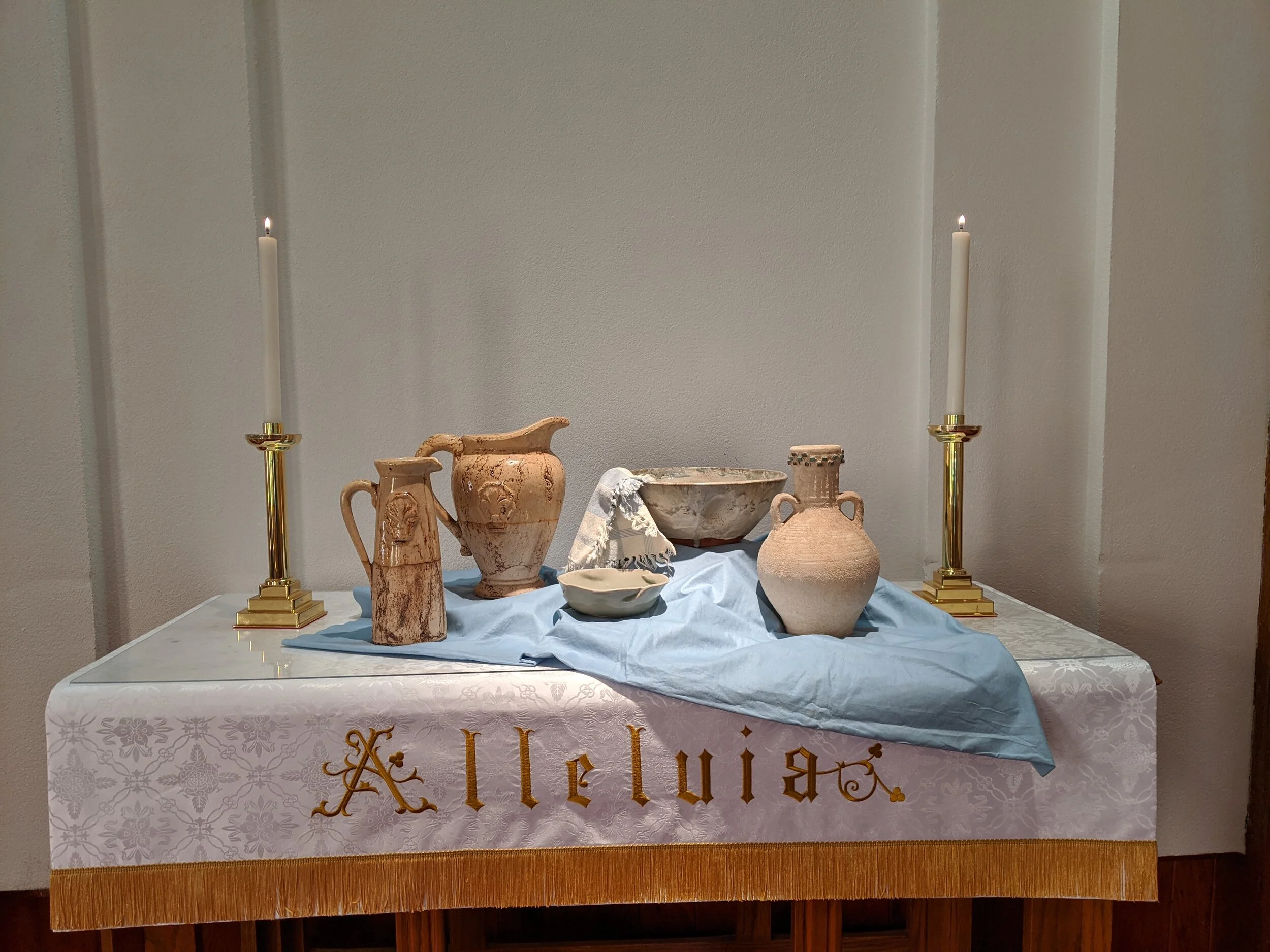
Freedom starts with belovedness. Freedom, for us Christians, starts with baptism. I invite you to join me in coming up to the font and meeting the water. Come up to the font and hear yourself named again as beloved, because you are. Each and every one of you are loved by God, a child of God in whom God is well-pleased, just as you are. Come to the font remembering your baptism, if you’ve been baptized, and delighting in love that God has for you. Let it fill your spirit and break apart any hardness in your heart. Or come to the font and experience that belovedness for the first time, if you haven’t been baptized before. Water surrounds us here on this earth, a sign of God’s abundant love for you, even if you haven’t been immersed in it yet.
Come, beloved. Come and see. Come and sing. Come and be freed.
Amen.
All text and pictures (unless otherwise attributed) © Jo Schonewolf, 2020. To view a full archive of our sermons, click here.