Below is a transcript of Pastor Jo Schonewolf’s reflection on this second Sunday of Easter, published on Sunday, April 19th, 2020. You can view the original video below.
Opening Prayer
God, our Holy One, as our spirits huddle together with grief and fear tangled together, let your peace be with us. Keep us from closing off our hearts to the world in pain. Wherever we encounter wounds, still tender from trauma or despair, may we be a healing presence, a community of compassion and solidarity. Amen. (adapted by Jo Schonewolf from enfleshed’s Liturgies that Matter)
John 20:19-31
20:19 When it was evening on that day, the first day of the week, and the doors of the house where the disciples had met were locked for fear of the Jews, Jesus came and stood among them and said, "Peace be with you." 20 After he said this, he showed them his hands and his side. Then the disciples rejoiced when they saw the Lord. 21 Jesus said to them again, "Peace be with you. As the Father has sent me, so I send you." 22 When he had said this, he breathed on them and said to them, "Receive the Holy Spirit. 23 If you forgive the sins of any, they are forgiven them; if you retain the sins of any, they are retained."
24 But Thomas (who was called the Twin), one of the twelve, was not with them when Jesus came. 25 So the other disciples told him, "We have seen the Lord." But he said to them, "Unless I see the mark of the nails in his hands, and put my finger in the mark of the nails and my hand in his side, I will not believe." 26 A week later his disciples were again in the house, and Thomas was with them. Although the doors were shut, Jesus came and stood among them and said, "Peace be with you." 27 Then he said to Thomas, "Put your finger here and see my hands. Reach out your hand and put it in my side. Do not doubt but believe." 28 Thomas answered him, "My Lord and my God!" 29 Jesus said to him, "Have you believed because you have seen me? Blessed are those who have not seen and yet have come to believe."
30 Now Jesus did many other signs in the presence of his disciples, which are not written in this book. 31 But these are written so that you may come to believe that Jesus is the Messiah, the Son of God, and that through believing you may have life in his name.
This is the word of God for us, the people of God. Thanks be to God.
On first glance, this passage is talking about belief. Thomas wasn’t able to believe until he sees Jesus’ wounds, but all of us, here today, even though we haven’t seen Jesus, we are blessed with our belief-at-a-distance. We are blessed with an imperishable inheritance because we believe the testimony of the faithful who have gone before us. It seems that belief is what’s important to the writer of the gospel of John.
And there’s a sermon in that, I suppose. Belief that God is with us, even when the world is falling apart, even when it doesn’t feel like it. Belief that in dying and being raised from the dead, Jesus ensures that we will we one day rise from the dead. Belief in the evidential proof of the miracles told in the Bible, as that last verse in John seems to suggest. But I don’t think any of those sermons are necessarily the sermons we need to hear today.
I think we need to understand why Thomas didn’t believe.
Because Thomas, of doubting fame, has not always been a doubter, as the gospel of John tells the story. Remember, years ago it seems, when Jesus was going to go wake up Lazarus, and the rest of the disciples were wary, but Thomas was ready to go? He said, “Let us also go, so that we might die with him.” That doesn’t sound like someone with a skeptical attitude to me. It sounds like someone who is very, very committed to following Jesus wherever he may go.
And yet, it wasn’t Thomas, or any of the twelve (probably) who followed Jesus to the cross and watched him die there. When the going got tough, the disciples got going. They hid for their very lives after Jesus was killed, even “Let us go die with him” Thomas. After all, Rome thought Jesus wanted to be a king. The religious authorities thought he wanted to be a Messiah. And while you might kill a movement by cutting off the head, as the authorities had thought they had, there was still a chance that Peter or one of the other disciples might try to start this rebellion up again.
This is why they hid, and I want to be very clear about this. The gospel of John is fairly antisemitic in its language, because the Church was trying to set itself apart from Judaism. When the gospel says, “They hid for fear of the Jews,” this shouldn’t lead us to think that we should blame Jewish people for Jesus’ death; we should remember how bitter and angry humans can be in a fight, even the gospel writers. In time that the Gospel of John was written, Christians and Jews were at odds. That doesn’t mean that we should accept the hate that resulted as gospel.
So the disciples were huddled in fear, as we ourselves might be on this day, though out of a different fear, on the day the Jesus arrives for the first time. Thomas has gone out into the hostile world, likely risking his life to get needed supplies for their quarantine, when Jesus comes back and says, “Peace be with you,” twice, to these men who ran away when he needed them most.
I know we’ve probably forgotten about Maundy Thursday and Good Friday during these weeks that seem like months, but remember, the disciples abandoned Jesus. They ran away to save their own skin. If I were them, the last person I would want to see, after the authorities who wanted to kill me, would be Jesus. If I were a disciple, I would not know what to say to Jesus after all of this.
And that is maybe the miracle of this moment, more than the giving of the Spirit, more than the loosing or binding of sins. In this moment, Jesus comes to those who have betrayed him, and offers them forgiveness. These men stood by and let Jesus die, and Jesus comes to them saying, “Peace.”
If Jesus had been most other gods, he would have exacted revenge, would have punished them with everlasting fire for abandoning him, after he called them by name, after they followed him for years. But Jesus is not like any other god. Jesus is God. And God, who is love, cannot do anything other offer forgiveness, even in a time like this.
So, of course, Thomas doesn’t believe them when he comes back. This is not the way the world works. The dead don’t rise, especially not the executed dead, and gods don’t offer forgiveness and kindness. The world Thomas knows is full of anger, and vengeance, and power. Comfort and acceptance don’t make sense to him. He has just seen his only hope at freedom nailed to a cross. He isn’t going to believe that freedom still lives until he feels the proof of it.
Imagine the pain Thomas is in. He had thought the world could be different, thought the world could be better, thought that the hate and fear and anger and oppression could all end with Jesus in charge, and he watched that hope die. He’s back into survival mode. No one can make him hope. No one can make him dream. It’s back to meeting basic needs, like food and water and shelter, and we’ll handle the rest later. That’s probably why he went out in the first place. Thomas, the bravest of them all, the readiest to put his life on the line, has gone out in public, meeting essential needs. He can’t believe that all the horror he’s experienced could be undone. He can’t believe that the horror he’s done can be undone. He can’t believe that Jesus could offer him forgiveness, not after all he’s done.
And yet, here is Jesus, saying, “Peace be with you.” Here is Jesus, really Jesus, Jesus in the flesh, showing Thomas his wounds. Here is Jesus, asking Thomas to be honest about his own wounds. Here is Jesus, saying, “Yes, we hurt. We all hurt. But look, I have overcome the hurt of this world. You needed to see this. I know. And because of you, generations after you will be able to overcome their hurt, to be forgiven of the hurt they caused. Your doubt, Thomas, will lead to the faith of many.”
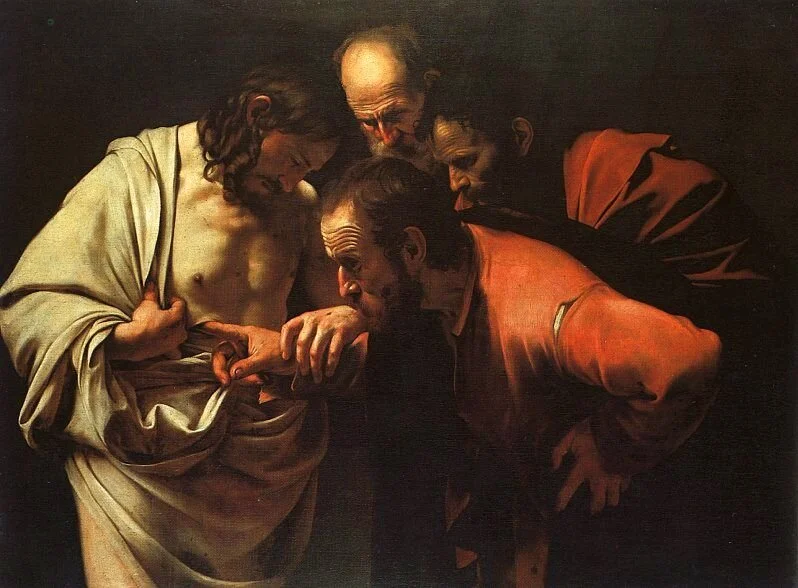
Friends, in our hurt, we doubt, just as Thomas did. It’s just what we humans do. But no matter how much we fear or doubt, Jesus is always ready to step among us and say, “Peace be with you.” Jesus is always more willing to forgive than we are to seek forgiveness. But this is the great promise of this passage, is that Jesus offer us amazing power. The sins we bind on this earth are bound, but the ones we loose are loosed. We don’t have to hold on to any of the hurt in our lives. We are free to let it go.
This time of quarantine lends itself to fear, I know, but it can also be a great time of introspection. What sin are you holding tight to, that you’re afraid to let loose? Is it one you’ve committed in the past? Is it one that has been committed against you? Is it one that you’re afraid will be committed? Friends, I invite you to spend time this week thinking about the sins that you are binding, and to work to let them go, even if that work will take longer than this week, because you, like Thomas, can be forgiven. You, like Jesus, can forgive. You have been given that strength. Be bold, and use it.
In the name of the Father, and the Son, and the Holy Spirit. Amen.
All text, footage, and pictures, unless otherwise attributed, © Jo Schonewolf, 2020. To view a full archive of our sermons, click here.