This sermon was preached at Whittier UMC on Sunday, October 20th, based on Genesis 32:22-31 and Luke 18:1-8. You can listen to the sermon by clicking below.
Would you pray with me?
God who stays with us in our struggle, thank you for bringing us to this time and this place. Make your presence known to us here today. And may the words of my mouth and the meditations of all our hearts be acceptable to you, our rock and our redeemer. Amen.
There are some things in this life that are first and foremost between you and God. There are some things in this life that tell you who you are and who God is.
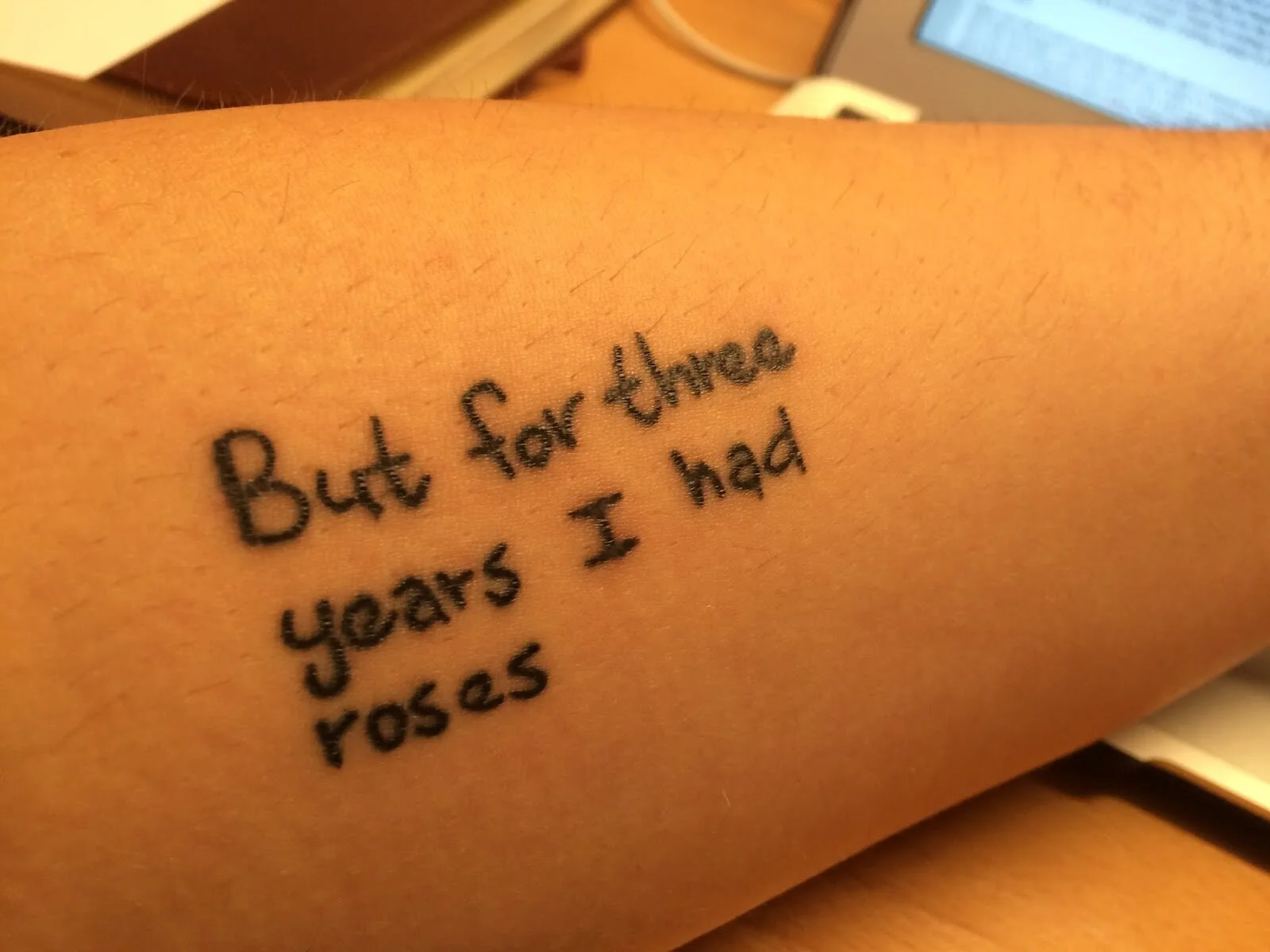
I have a tattoo on my left forearm that says, “But for three years I had roses.” It’s one of four tattoos that I have: I have the Hebrew letter bet on my right ankle, which I think most of you have seen; I have a pair of wings on my left shoulder; I have this one on my left forearm; and I have one on my right elbow that says “SKWAD,” which is the result of a pinky swear and a long story. Each tattoo is a part of my story, a marker of a point in time on my journey to becoming who I am and leaving behind the hurtful parts of who I was. Jacob walked with a limp; I have my tattoos.
“But for three years I had roses” is a part of a quote from the movie V for Vendetta. It’s said by Valerie, a character who has had the very worst in life happen to her, but who has come to terms with it. She says, “But for three years I had roses and apologized to no one. I shall die here. Every inch of me shall perish. Every inch, but one. An Inch, it is small and it is fragile, but it is the only thing the world worth having. We must never lose it or give it away. We must never let them take it from us.”
Valerie is imprisoned as she says this. She’s writing down her story, what has happened to her and how she’s made sense of it, on a tiny piece of paper that she passes to the inmate in the next cell over. The inch that she talks about is her integrity, her knowledge of who she is and what she knows to be true, and what she knows to be true is the power of love in the face of fear and hate. She ends her story by saying, “I hope that whoever you are, you escape this place. I hope that the world turns and that things get better. But what I hope most of all is that you understand what I mean when I tell you that even though I do not know you, and even though I may never meet you, laugh with you, cry with you, or kiss you. I love you. With all my heart, I love you.”
Valerie’s story is what drives the movie’s main character, V, to fight for justice, to struggle against the wrongs that he and others have endured. Her self-knowledge in the face of all she’s endured and her insistence on integrity based in hope and love drives others to strive for justice. Valerie knows who she is. She struggled and fought for that knowledge and she won’t let anyone take it from her. For three years, she had roses. She lived in goodness and integrity and love. No matter what the world has done to her, she will always have that.
As someone who has struggled to know who I am and what I believe in, I’m inspired by Valerie’s story and in this quote. It encourages me to continue to do the hard work of learning who I am and living out of that knowledge, rather than trying to be who others want me to be and living into that expectation. On my last day (maybe it be far in the future), I want to be able to look back and know that I too had my roses, because I know that it’s out of self-knowledge and conviction that I’ll be able to make a difference in this world.
The journey to know who you are and what you believe can be a long one, taking years, sometimes decades, but there are some, like Valerie, who have touchstone moments that clarify the question for them. Jacob is another one of those people. His touchstone moment is our Old Testament lesson for this morning.
Jacob has come to this place, beside the river Jabbok, because he’s about to confront his older brother Esau, the one whose birthright he stole. Jacob’s name means “he takes by the heel” or “he supplants,” so Jacob has really spent his whole life building up to this night, where his reckoning for supplanting his brother comes home to roost. He sends his family and everything he has on ahead so that whatever may happen in the morning happens to him and him alone.
Jacob is ready for this fight with Esau. He knows what’s about to come the next day.
But it’s not clear that he knew what would happen that night. It’s not clear whether or not he expected the angel that comes to wrestle with him.
We don’t get any details about the fight, except for the very end. We don’t know if they tore up the land as they wrestled, if they said anything to one another, if Jacob slammed the angel to the ground or the angel flew up into the air in order to get an advantage. We don’t know any of that. What we do know is that Jacob struggled all night with the angel and it was clear that the angel wasn’t going to win. So the angel cheats. He hits Jacob on the hip socket and knocks it out of place.
But even then, Jacob doesn’t give up on the struggle. He’s clinging on to the angel when the angel sees that it’s about to be dawn. Jacob holds on to the angel until the angel blesses him. He knows that this is no ordinary wrestling match and he knows that he's won. Before, when he was stealing Esau’s birthright, he and his mother tricked his father to get his blessing. But this time, Jacob's earned this blessing.
And the angel gives it. The angel gives Jacob a new name: Israel. The one who struggles with God.
Jacob could have been content with that, with this new identity that supplants his old one, but he takes it one step further. See, in the ancient world, if you know someone's name, you have power over them. Jacob, not satisfied with his blessing, asks for the name of the angel he's defeated. The angel refuses, though, and that's when Jacob knows for sure that it wasn't an angel that he was struggling with this whole time; it was God.
It's now morning and he's stayed up all night fighting. He gets himself ready for another fight, this time with his brother, but instead of fighting him, Esau embraces him. Turns out that Jacob's fight had only ever been with God and with himself. In struggling with God, in learning his new name, Jacob finds himself.
And just as with Valerie, the result of Jacob's struggle with God and with himself sets the tone for the rest of the history of Israel. Israel will continue to be the people of God, the people that God will continue to get into their struggles with. Through judges and kings and prophets and empires, God will struggle right alongside (and sometimes with) Israel.
Because remember, God could have, at any point in the wrestling match, stuck Jacob's hip and won immediately. It tells us something about God that God is willing to get down in the mud with us and duke it out. It's not something that God needed to do. It's something Jacob needed from God. It's something Israel needed from God. Sometimes in our lives, in important times in our lives, I think we need God to come down and struggle with us, so that we can know who God is and who we are. When God does that, when God comes to us in the midst of the struggle, we figure things out. We find out who we are. And that knowledge changes everything.
The story of Jacob tells us a good plenty about these touchstone moments in our faith, these moments in our lives that help us know who we are and who God is. The first, which we just talked about, is that we have a God who will get into the mud with us, a God who will struggle with us when we need it. A corollary of that, the flip side of that, is that we have a God that it's okay to wrestle with. It's okay to doubt. It's okay to ask questions. It's okay to lose faith and to struggle, because God joins us in the struggle. When we're in doubt, when we're afraid or apprehensive, when we don't know what tomorrow will bring, God joins us.
The second thing we learn is that sometimes we think our fight is with someone else, but our fight is actually with God and with how we see ourselves. We might walk through our days agitated at this or that family member or heartbroken over this friendship or that relationship and never once think that the pain we think they're causing us is actually a pain that we've been carrying around all our days. I know that I'm perpetually afraid of being abandoned by those who care for me, of being left on my own without friends or family, without God, and that fear is something that belongs only to me. It's not my partner's responsibility to take on that fear or deal with the anger that grows out of it. That's work that I have to do, a fight that I have to have with myself and with the God who made me this way and let me grow this way. Just as Jacob had prepared himself for a fight with his brother, we prepare ourselves for fights with everyone around us. But Jacob didn't need victory over Esau; he needed a new name, a new way to understand himself. Sometimes, that's what we need too.
And third, Jacob's story teaches us the importance of persistence, just as Jesus' story of the widow does. It's just a couple of lines in the story, but Jacob wrestles all night long and even after he's been beat, he doesn't let go. The widow comes back again and again to demand justice, so often that even an unjust judge gives her what she asks for. Determination and persistence go a long way when it comes to our relationship with God. When we notice that there’s something off in our spirits, when we come to a thorny place in our faith, when we find ourselves confronted with a difficult situation, it’s not necessarily our place to know the answer right away, to be able to point to a bible verse and gain blessed assurance. Sometimes, maybe even many times, it’s our place to struggle and to come back to the struggle again and again.
I have four tattoos. Each one of them grew out of a struggle. My wings grew out of my struggle to understand that God made me good, just as God makes all of us good, and that God made me capable, just as God makes each of us capable in our own unique ways. My roses quote came out of two years of contemplation about where I wanted the bedrock of my life to be; I decided that it would be honesty and love, and I struggle to live into that decision every day. The SKWAD tattoo is a memorial to the challenges and benefits of overseas friendships and finding your own way in this world. The bet reminds me that though the past can suck you in, God always aims us forward. My tattoos are hard-won battle scars, the visible signs of persistent wrestling. I may never get another but I’m happy to wear them for the rest of my life. They remind me that I too get to be Israel. I too get to stay up all night wrestling with our God who is Love, our God who is with us, our God who never lets us go, and on the other end, I’ll know myself and my God better. And that, though a struggle it may be, is a good and joyful thing.
Amen.
All text and pictures (unless otherwise attributed) © Jo Schonewolf, 2019. You can read all our sermons by clicking here.