This sermon was preached at Whittier UMC on Sunday, October 13th, based on Luke 17:11-19. You can listen to the sermon by clicking below.
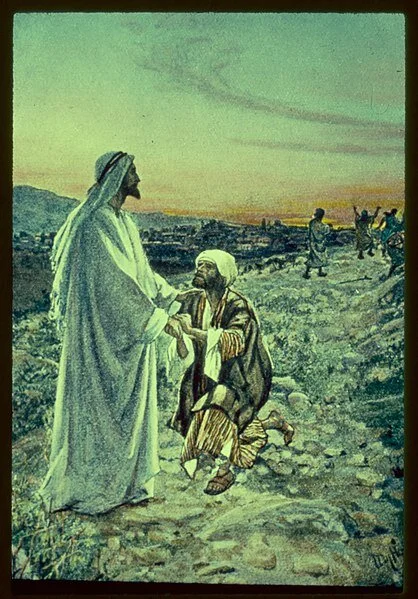
Image from the Library of Congress’ Catalog
Would you pray with me?
God of the healed and God of the sick, thank you for bringing us to this time and place. Be with us here today. And may the words of my mouth and the meditations of all our hearts be acceptable to you, our Rock and our Redeemer. Amen.
I have this mirror in my house. It sits in a nook in the middle of the dining room and I think it’s meant to be a space where you display your fancy glasses and things. But, since I’ve moved around so much, I don’t have fancy glasses so much as I have “stemless wine glasses I bought at Target” and since this mirror has consistently scared the bejeezus out of me every time I’ve come home after dark, I decided to take it down and turn the space into a coffee nook. I might not have fancy glasses but, having just finished grad school, I do have an abundance of coffee mugs.
Now, as a renter, I don’t usually make decisions this big about a house. Like Jeremiah and the exiles, I mostly decide to make do with whatever the house has to offer, to grow where I’m planted, as they say. But it’ll be easy enough to put the mirror back whenever I move out and moving the mirror will stop me from jumping out of my skin every time I see a stranger in my house only to realize it’s my own reflection, so I feel okay about having taken it down. And when I did move it, I found at least a decade’s worth of dust and grime behind it.
And I was delighted.
I may be alone in this, but I love doing a good deep clean. Give me floorboards that haven’t been wiped down in years and I’m in heaven. I like doing this cleaning work because it’s easy to see when you’re making progress and because you feel such a sense of accomplishment at the end. Getting rid of grime makes me happy because it’s an accomplishable task that I can take a sense of pride in. So once I’d moved the mirror, I broke out my cleaning supplies and went to work. About half an hour later, I had a sparkling new coffee nook, ready for all my caffeine needs.
And thinking about our gospel passage today, something tells me that Jesus loves a good deep clean too. Jesus is on his way to Jerusalem, where he knows that he and the leaders of this world will clash, a clash that will inevitably lead to his death, but along the way, he keeps on stopping. He stops to eat with people and to teach, yes, but he also keeps stopping to heal. In chapter 13, he heals the woman who had been bent over for eighteen years. In chapter 14, he heals a man with dropsy. After our story this morning, he’ll go on to heal a blind man, and these are just the healings that Luke records on the way to Jerusalem. How many more didn’t make it into the text?
I think Jesus stops so often on the way to Jerusalem to heal people because he delights in the task, just as I delight in deep cleaning. Healing is a way that Jesus can set something right, to release people from pain and restore their bodies. And in the case of the ten lepers, it is an actual cleansing that happens.
I’m sure you’ve heard a thousand times about how leprosy impacted the person who contracted it. The Greek word here, λεπρός (lepros), is a catch-all for all sorts of skin conditions, some contagious and some not, some curable and some not. But because there were skin diseases that were very contagious, anyone with a skin condition was considered unclean and was sent out of the city or town or village to live. It was a way of keeping everyone else safe. And since they were considered unclean, both medically and socially and religiously, only a priest could declare a person clean again if their condition abated.
So when ten men with leprosy cry out to Jesus on his way between Samaria and Galilee, I like to imagine that he’s actually happy to hear their voices. They keep their distance because they’re trained to; they’ve spent the years of their lives with leprosy having to yell, “Leper!” any time they approach another person. But the distance doesn’t stop them from calling out to Jesus and it doesn’t stop Jesus from hearing them. I imagine his heart breaking with compassion for these men, then bursting with joy as he sets in motion their healing and sends them to see the priests. Not only has he restored their bodies, he’s restored their connection to the community and to God. With one act of healing, he’s cleaned up years of pain and separation and feelings of unworthiness. He’s done this good and joyful thing. I can’t help but think that Jesus rejoices in this.
Because these are people who were told to make do with what they had. Like the exiles and Jeremiah, they were told to grow where they were planted, to flourish as best they can, because that’s all that they could expect from life. They formed a community of lepers and had whatever fellowship they could, because they knew that a life with a larger community wasn’t open to them. They survived, yes, they got through each day, yes, but the fullness of life was never theirs.
But when Jesus heals them, that full life is open to them again. They can go see their family again. They can see their friends. They can worship in the temple. They can sleep in a house. They can hold their children or their grandchildren again. They can pray to God knowing that they are worthy in God’s sight, that they are clean before the Lord. It’s no wonder that nine of them don’t come back to thank him. They’re probably being surrounded by the love and rejoicing of those they’d lost when leprosy struck them.
I imagine these scenes of reuniting after the priests declare them clean, the tears in their eyes. I imagine Jesus smiling at the thought of all the goodness that this healing has brought into the world, a happiness that fades when only one of the men comes back. “There were ten of you,” he says to the man who came back, rejoicing with him and receiving his thanks, but confused. “Where are the other nine? You didn’t stay together?”
See, before, when they were all lepers, it didn’t matter that this one man was a Samaritan. As far as the world was concerned, they were all just men with a skin disease, men to be avoided. They were equal in their disease. They were united in their disease. They grew where they were planted and they were companions, even though Jews and Samaritans didn’t associate with one another out there in the world of clean people. And Jesus had seen in these men, who all cried out to him together, a unity that he hoped they’d honor once they were healed. He saw goodness already and removed their obstacle from sharing that goodness with the rest of the world.
But when he sees that this hasn’t happened, he turns to the man who’s come back to thank him, still on the ground, still giving glory to God. “They didn’t come back with you, did they?” he says to the man, aware that even in this moment of joy, there is a loss, a loss that Jesus feels in his spirit too. So he offers the man comfort. He pulls him up, smiles at him, puts a hand on his shoulder, and says, “Go. Your faith has made you well.” And as he goes on to teach, after having experienced this moment with the men with leprosy, he reminds anyone who will hear that the kingdom of God is already among you. You don’t have to wait for the goodness and freedom and unity and peace that the kingdom promises. It’s breaking through in this world every day. He’s seen it amongst the men with leprosy.
Now, I know that this retelling of the story gives Jesus many more emotions than are stated or implied in the text. I know it fleshes out the situation and teases out some implications that Luke doesn’t state outright. But this joyful, concerned, loving, compassionate Jesus is the Jesus that I know and I can’t help but see him as I read this text. I need to know that there is grace in his eyes when he speaks about the other nine lepers, because I know that I’m one of the nine.
How many times in my life have I found myself united with unexpected people through a shared loss or a shared pain or through a sense of being on the outside? And how often have I left that community behind without a second thought because something new and life-giving came my way? How often have I failed to honor those who walked beside me through a difficult time? How often have I been concerned with setting my life back up again after a season of distress without a single word of thanks to the God of goodness who made my new life possible? How often have I moved past my pain with relief and set my eyes only on the future, my future, the future that I think I’ll make possible without God and without others? How often do I fail to look back?
I love cleaning. It’s a simple task, one that I’m prepared for, one that I can do by myself and feel a sense of accomplishment after. But what we so often need is healing, not cleaning, and our parable this morning shows us that for that, we need much more. We need a community around us to support us. We need God’s grace to sustain us. And for the healing to stick, to really do its work truly and thoroughly, we have to be grateful. We have to recognize the work that God has done and celebrate it.
Because when Jesus heals us, when we embark on this life-long journey of healing that Jesus offers us, he doesn’t just heal the things that hurt us, he heals everything within us that could hurt another. Jesus had thought that in healing the ten, he would be setting in motion a healing that would spill on to all those around them. The ten lepers had learned how to live without the dividing line of Jew vs. Samaritan. Jesus thought that they would keep that knowledge, that goodness, that healing of division, with them after he healed their bodies. But they didn’t. They moved on to lives with newly healed bodies and newly damaged spirits, spirits damaged by the separation between Jews and Samaritans, spirits that would, of course, go on to damage others.
When Jesus heals us from whatever ails us in our lives, he intends for that healing to stick and for us to go out and spread that healing to others. He intends for that healing to build togetherness, not separation. Because what Jesus desires for us more than anything else is a full life, a life bursting with love and joy and goodness and compassion, the life that God created us for. And that life, that full life, will be one that is full of thankfulness not only for now, but also for what has come before. That’s how God heals us.
So friends, I invite you as you go throughout the rest of today and the rest of this week, to reflect on the healing God has done in your life and the healing God still wants to do in your life. Give thanks for places where God has already brought you into the fullness of life and ask God for healing for the places that still hurt, in your body, in your mind, in your spirit, and in your relationships. Pray for healing knowing that God delights in doing it, so that we may share joy with God and with one another.
Amen.
All text and pictures (unless otherwise attributed) © Jo Schonewolf, 2019. You can access our full sermon archive by clicking here.