This sermon was preached at Whittier UMC on Sunday, September 22, 2019, based on Jeremiah 8:18-9:1. Click below to listen to a recording of the sermon.
Would you pray with me?
God of joy and God of mourning, thank you for bringing us to this time and this place. Be with us here today. And may the words of my mouth and the meditations of all our hearts be acceptable to you, our Rock and our Redeemer. Amen.
Over the past few weeks, we’ve been talking about some enduring biblical images: the potter and the lost sheep. These images become part of our language as Christians, part of our way of talking about the world. We Christians love our Bible and scripture becomes an everyday part of our speaking. Some of these things aren’t actually in the Bible-- the Bible never actually says that God won’t give you more than you can handle, for example-- but they’re all part of that “Christian-ese” that we speak sometimes when we’re being churchy.
I bring this up this morning because the balm of Gilead was a part of that Christian-ese for me. I’d heard it in church in my life and assumed it was something from the Bible but I didn’t learn about the spiritual or the passage that it came from until this year. It was a part of my Christian vocabulary but I didn’t really know what it was.
It’s actually only mentioned a few times in the Bible, here in the passage from Jeremiah and earlier in Genesis, when Joseph, of many-colored-coat fame, is sold to some Ishmaelites who are coming up from Gilead, bringing balm and other supplies. Balm and balsam are mentioned in other places, usually as expensive gifts for rulers or trade items, but the references in Genesis and Jeremiah are the only two specific references to the balm of Gilead.
And yet, despite being only briefly mentioned in the Bible, the balm of Gilead has become an almost-universal biblical image for a healing ointment, even though no one’s really sure exactly what it did or what plant it came from. Most researches agree is that it’s a type of balsam plant, which is an evergreen plant, as we might guess given our abundance of balsam fir trees in our Great Balsam Mountains. It was a small shrub with rounded leaves, similar to a holly bush, though less dense.
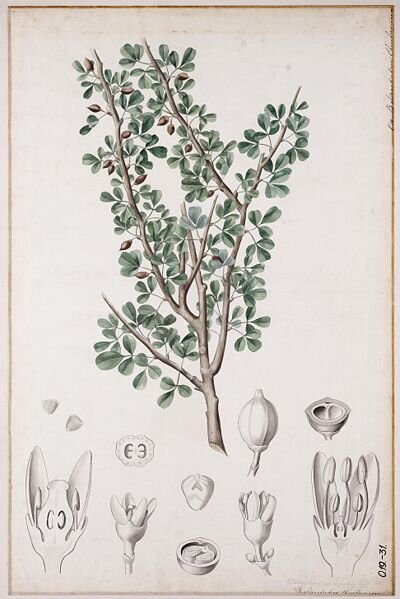
Commiphora gileadensis, the Arabian balsam tree. (public domain)

The balm was made from the resin of the plant, which either weeped from the bark or seeped out when cut. There’s some history in this region of folk medicine making balms from similar plants that are native to this land.
So balms in general we’re familiar with, but the specific balm of Gilead, whatever it was, became a part of our modern-day Christian vocabulary because of the spiritual, which I’m sure many of you are familiar with. Some things become holy to us because they’re parts of a biblical story and some things become holy to us through music. This spiritual is a perfect combination of the two. The balm of Gilead becomes associated with almost mythical healing because the spiritual ties it to Jesus’ power to heal our souls.
Now, that understanding of the balm of Gilead is an expansion of what the Bible says about it. We do this all the time as Christians, especially when it comes to music, and it can result in something simple and straightforward taking on a deeper meaning. It makes it stick better. When it’s a word from the Lord, when it’s a message that sets people free, encasing it in music and sharing it is a good and joyful thing.
But the passage from Jeremiah this morning, the only place to mention the balm of Gilead directly, isn’t exactly joyful. It’s funny to me that the people who designed our bulletin cover picked this passage for the image. It’s by no means a peace-filled transition between seasons. The full quote is, “‘The harvest is past, the summer is ended, and we are not saved.’ For the hurt of my poor people I am hurt, I mourn, and dismay has taken hold of me.” And then we get the famous line, “Is there no balm in Gilead? Is there no physician there? Why then has the health of my poor people not been restored?”
See, Gilead was famous for its balm, so famous that Jeremiah assumed everyone would know about it without him having to explain it. It’s the equivalent of saying, “Isn’t there morphine in this Emergency Room? Aren’t there doctors? Then why are we still in pain?” There is a balm in Gilead, one well-known for its healing powers. There are healers. And Jeremiah’s people are still sick.
We have to read earlier in the chapter to see why healing has not come to them. Jeremiah rails against the false prophets, the people who call themselves prophets but are really just speaking on behalf of the establishment. In verses 10 and 11 of chapter 8, Jeremiah tells us, “everyone is greedy for unjust gain; from prophet to priest everyone deals falsely. They have treated the wound of my people carelessly saying, ‘Peace, peace,’ when there is no peace.”
Jeremiah knows that the Lord’s commandments are not being upheld. The people that God told Judah to care for were not being cared for and instead of turning to follow the Lord, the people in power were crying, “Peace, peace,” in the face of strife. There could be no healing because those with the power to help denied that there were problems.
And for Jeremiah, there’s nothing in this world that can bring healing unless these people changed their ways. Even the famous balm of Gilead isn’t enough. There must be repentance. There must be a change in behavior. Things cannot stay as they are. Otherwise, Judah will only get sicker. The prophets who assure the people that all is well when a conquering empire is looming only offer false hope. For true hope, real, life-changing, energizing hope, the kind of hope that can set you on the road to healing, the problem has to be faced.
This is true for nations and this is true for each of us. I know it’s a truism, but admitting that you have a problem is the first step to recovery. Understanding that something is not right in your spirit is the beginning of salvation. Knowing that all is not well within you sparks you to seek help. Repentance, reconciliation, restoration, they all come after acknowledging that something is wrong.
And mourning comes hand-in-hand with acknowledging that something’s wrong. Mourning is a sign that you are allowing yourself to feel the depth of the problem, that your empathy for others and for yourself is intact. Now, I want to be clear here: mourning isn’t self-hated. Mourning isn’t total, unending despair. Mourning isn’t allowing yourself to be forever and always overwhelmed by the weight of the world’s sorrows. Mourning is a true and deep sadness as a response to the pain of the world, inside and outside of ourselves, a grieving of loss. The book of Jeremiah is a case-study of a person in mourning, responding to trauma and trying to make sense of it. Jeremiah understands that something is powerfully wrong in Judah and he mourns it.
Now, I’ve been saying throughout this sermon that we have to acknowledge that something’s wrong or that there’s a problem, but the language Jeremiah uses here is sin. It’s a word that has taken on a whole other meaning in the Christian-ese of our time, a weapon of shame and imprisonment, and so I like to be careful with it.
By sin, I don’t mean violating a code of politeness and good behavior. It’s nothing as simple as that. But I think we all can identify the things inside of us that hurt ourselves and others, the things that fracture our relationships and that keep us from being in kind and caring community with one another, the things that keep us from God. To me, those things are sin. Our damaged relationships, with one another and with God, are what cause a sin-sick soul.
John Wesley, the founder of Methodism, often talked about sin as an illness, just as Jeremiah does here, and I find that a helpful way to understand it within ourselves, especially if we think about it as a chronic illness. It’s not that you’re a sinful person, a person made of sin and shame and mistakes; instead, we are all people who live with sin in our daily lives. Some days are better and some days are worse, and if we have medication, more days will be better instead of worse. We know that there is a balm in Gilead and it can heal the sin-sick soul.
Now, as I’ve said before, I believe that what we do in worship changes what we do in the world. Worship, if we’re doing it right, is a part of our healing. It’s our balm. Worship can convict us of our sin, it can alert us to what’s not right inside of us, and send us on that process of acknowledging the problem and mourning it, but worship can also provide the healing that we need. We know that music can be a balm to the soul. Prayer can be as well. Fellowship and community are too. Knowing that you are supported and loved makes a universe of difference when you feel isolated and unlovable. It gives us hope, real hope, that even in the face of the world’s problems, in the face of our own problems, God can work with us and within us to bring about something better. Gathering in worship can be a powerful part of our healing and then we, as the healed, are better able to go out and be the healers for others.
God speaks a hope for our future, a hope for healing, through worship. But worship doesn’t only happen on Sunday mornings. It happens when you pray, no matter where you are. It happens when you sing or laugh or make a joyful noise of any kind. It happens when you fellowship outside of these four walls. It happens when you listen and learn, when you engage with those around you, whether you know them or agree with them or not. God can work astounding healing through worship, even if it’s not in this time and this place.
And if we’re healed, I honestly and truly believe that we will carry healing within us to the rest of the world. When we learn to recognize what’s ailing us, to mourn it, and to seek healing for it, we can share that with the world. We can offer them hope that isn’t based in crying peace, peace when there is no peace. We can offer them hope based in the healing that comes through God.
So friends, as we go about this week, I invite you to do as Jeremiah encourages us to do: be honest about what is not right in your souls and in your world. Mourn the pain that arises because of that. And then seek out the balm of Gilead in your world, those moments of prayer, praise, fellowship, and understanding. Because we know our God is faithful to offer healing to those who seek it. There is indeed a balm in Gilead that can heal a sin-sick soul and a sin-weary world.
Amen.
All text and pictures (unless otherwise attributed) © Jo Schonewolf, 2019 . To see our full sermon archive, click here.