This sermon was preached at Whittier UMC on Sunday, September 29, 2019, based on Luke 16:19-31 Click below to listen to a recording of the sermon.
Would you pray with me?
God of the poor and God of the rich, thank you for bringing us to this time and this place. Be with us here today. And may the words of my mouth and the meditations of all our hearts be acceptable to you, our Rock and our Redeemer. Amen.
I meet with what we call a lectionary group on Monday mornings. It’s pastors and people doing Christian mission work in the area and we get together and read the lectionary texts for the week and talk about what they mean and what we’re going to preach on. It’s kinda like a sermon study group, with people from all sorts of different Christian backgrounds: Methodist, Baptist, Presbyterian, non-denominational. We have some really good conversations, usually a couple of hours of figuring out what all these words mean for us here today.
I bring this up because one of the questions from the group on Monday inspired me to do something a little different with the sermon this morning. See, I know exactly what I think this passage is about. The truth that it speaks to me is so clear that I couldn’t see any other until we discussed in it lectionary group. We ended up having a long and important discussion that had nothing to do with what I thought the passage was about. It is always a beautiful thing to be reminded that other people think differently from you, that we are each different people living as embodied spirits and inspirited bodies with different experiences and ways of moving through this world.
Now, to be clear, I didn’t change the way I read the passage because of this conversation. Again, the truth that I see in it is so strong that, while I understand this other reading, I could never preach it.
See, my preaching grows out of my years of discipleship and my years of study, my years of trying to figure out how to be a follower of Christ in this world that is so different from the Gospel he preached, but it also grows out of the exegesis I do. Exegesis is the process of drawing everything you can out of the text, to get the fullest idea of what, in this case, Jesus is saying. It’s my exegesis along with my faith that makes it so clear to me what this passage is about. And so this morning, I want to take you along on part of that process. I want us to some exegesis together and then I’ll share what I think Jesus is calling us to do in this passage.
This will mean that you’ll need bibles, either the pew bibles or you own, if you brought it. I’ll be working from the Common English Bible translation, which is what’s in the pew. It also means that I’ll be asking you questions and I want you to respond. I promise they’re not scary questions. The answers will be all right in front of you if you have Bibles.
(This is one of those “you had to be there” sermons, where congregational participation was particularly important, which means it may be clunky to read. If you read through it with your Bible in hand, though, you’ll be able to follow along and do on your own some of the work that we did together on Sunday.)
Okay. First things first: we have to read the passage. It starts on page 1273 in the pew bibles. We heard it once before, but let’s read through it again.
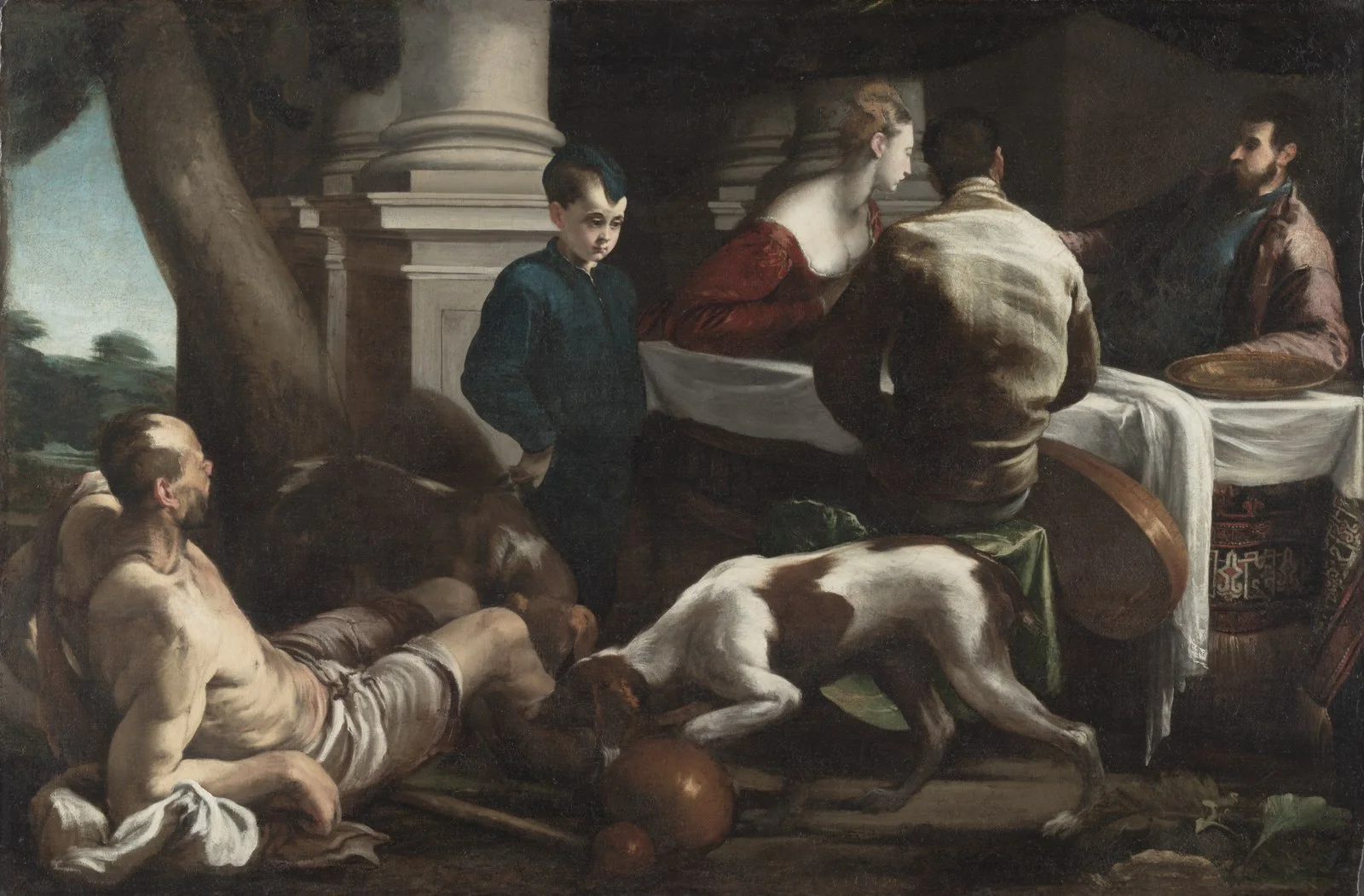
“There was a certain rich man who clothed himself in purple and fine linen, and who feasted luxuriously every day. At his gate lay a certain poor man named Lazarus who was covered with sores. Lazarus longed to eat the crumbs that fell from the rich man’s table. Instead, dogs would come and lick his sores.
“The poor man died and was carried by angels to Abraham’s side. The rich man also died and was buried. While being tormented in the place of the dead, he looked up and saw Abraham at a distance with Lazarus at his side. He shouted, ‘Father Abraham, have mercy on me. Send Lazarus to dip the tip of his finger in water and cool my tongue, because I’m suffering in this flame.’ But Abraham said, ‘Child, remember that during your lifetime you received good things, whereas Lazarus received terrible things. Now Lazarus is being comforted and you are in great pain. Moreover, a great crevasse has been fixed between us and you. Those who wish to cross over from here to you cannot. Neither can anyone cross from there to us.’
“The rich man said, ‘Then I beg you, Father, send Lazarus to my father’s house. I have five brothers. He needs to warn them so that they don’t come to this place of agony.’ Abraham replied, ‘They have Moses and the Prophets. They must listen to them.’ The rich man said, ‘No, Father Abraham! But if someone from the dead goes to them, they will change their hearts and lives.’ Abraham said, ‘If they don’t listen to Moses and the Prophets, then neither will they be persuaded if someone rises from the dead.’”
-Luke 16:19-31
Questions for exegesis:
1. Who are the characters in this story?
a. There are actually some other off-stage characters. Who’s telling the story?
b. Who’s he telling it to? Look back a couple of verses and see if you can figure it out.
c. Who are the Pharisees?
So now we’ve bumped on something important, something we don’t fully understand but is an important part of the passage. It matters who Jesus is talking to. We need to get some context.
2. What gospel are we in?
3. And who was Luke written for? (According to the introduction to the gospel, it’s written for Theophilus, a rich non-Jewish patron, so we can assume it’s aimed at a Gentile audience.)
Luke was written for people who don’t know who the Pharisees are. They just have to take Luke’s word for it. And at the time Luke was writing, early Christianity is trying to separate itself from the Judaism of its time, while Judaism is also trying to redefine itself after the rise of Christianity and the destruction of the Temple by Rome in 70 CE. There were disagreements between Christians and between the Pharisees, those who fundamentally shaped Judaism as it is today, though Judaism has grown as much as Christianity has in the thousands of years since this gospel was written.
So Luke portrays the Pharisees as “lovers of money” who were always antagonistic to Jesus. They get demonized over the course of history. But that’s Luke’s bias showing through, not something that is necessarily true. Sure, Jesus is arguing with them here, but Jesus himself could have been a Pharisee, since Jesus is referred to as a rabbi throughout the gospels and Pharisees are the group that start rabbinic Judaism. At this moment, Jesus is talking to Jewish people about how best to be Jewish, and he’s doing it through a parable.
So we’ve got Jesus talking to the disciples and the Pharisees and in order to get a point across, he tells them this parable with Lazarus, the rich man, Abraham, and a couple of angels. He’s talking to some rich people and some poor people, some people in power and some people who are pretty powerless. Let’s walk through what happens.
4. What are the places in this parable?
So the King James says, which is a literal translation of the Greek, is that Lazarus is taken to Abraham’s bosom. It’s become a literal place in some conceptions of the afterlife.
And it’s Hades, not hell. When we think Jesus is talking about hell, he’s often talking about Gehenna, a trash heap that burned outside Jerusalem, or the “outer darkness.” The Jewish conception of the afterlife that we find in the Old Testament was a place called Sheol, which was not heaven and hell, but just a place where the dead go and slept. So Hades is a Greek idea, an idea that the Gentiles would understand. It’s a pretty unique way to talk about the afterlife for Jesus.
5. What does Lazarus do in the parable?
6. What does the rich man do?
7. What does Abraham do?
8. What does Lazarus want?
9. What does the rich man want?
10. Who is beloved in this story?
Okay. So we know this story. Lazarus sits outside the gate of the rich man with his sores and wants food. He and the rich man die. Lazarus goes to be with Abraham, the rich man goes to Hades, and they’re separated by a great chasm. The rich man wants one drip of water but he can’t have it, so then he wants Lazarus to go tell his brothers how to avoid this fate and Abraham says that they need to listen to Moses and the prophets.
11. So what’s the story about?
Let’s put a pin those ideas and look at one more piece of context. Let’s see where this parable comes in Luke. I’ll give you one piece of information: this is in the “travel narrative” in Luke, where, from chapter 9 to chapter 19, Jesus is travelling to Jerusalem, though he gets distracted along the way. This is where Luke puts most of Jesus’ teaching. In Mark, Jesus’ teaching happens while they’re still in Galilee. In Matthew, most of it’s in the Sermon on the Mount, and in John it happens at the Last Supper. But in Luke, it’s while Jesus is headed toward Jerusalem, feasting and teaching all along the way.
So what happens on this journey? Let’s look. Flip back and just shout out things you find in the previous couple chapters.
And now let’s look ahead.
Now, here’s the kicker: Jesus’ parables are usually grouped thematically, like the lost sheep, the lost coin, and the lost sons from a few weeks ago are all about lost things being found, telling us about this God who seeks. What is this parable grouped with? The dishonest manager and teachings about wealth.
So, knowing this, what do we think this parable about?
Money.
Money.
Money is usually a good guess for what Jesus is saying. Almost half the parables are about it. One out of ten verses in the gospels is about it. The only thing that Jesus talks about more than money is the kingdom, the coming reign of God.
And that is why I wanted y’all to do this exegesis along with me this morning, because this is not going to be the last time Jesus talks about money or something else that might make us uncomfortable. But when we do this work, when we dig into this text, we get a clearer picture of the Jesus of the gospels rather than the Christ of the rest of the New Testament. We find Jesus in the gospels over and over again being concerned with the lost and the least, the outcast and especially the poor. We can’t ignore it. We can’t spiritualize it away.
This parable is so clearly about money to me. This parable is about how money divides us. This parable is about how love of money on the part of the rich keeps the poor, poor. This parable is about how our God is a God of reversals, a God who has preached through Moses and the prophets that we have a responsibility to care for the poor. We cannot disregard the poor. We cannot step by them. When the rich man does, he’s separated from Abraham and from the promise of being with God. This parable tells us that we who have wealth cannot ignore the poor and also be with God.
This parable is about what we do here and now, in this world. As Jesus says, we already have the law and the prophets. The law and the prophets tell us over and over again that we disregard the poor to our detriment. And that’s what Jesus is saying here, in a hyperbolic way, in an exaggerated way. What we do here matters. Who we care for here matters. What we do here and who we love here echoes into eternity.
But that’s uncomfortable for us. We don’t like it when people talk to us about money, and we don’t like to hear that what we do with our money matters. I know it’s uncomfortable for me. I make $36,000 a year, with a $15,000 housing allowance. This is the most money I’ve ever made in my life and that’s why this passage disturbs me so much. My needs are met, would be more than met if I didn’t have student loan debt. I’m not Lazarus in this parable; I’m the rich man. Who am I ignoring while I stand here, relishing in my purple robe? Which of God’s beloved am I failing to see?
And so, because this is an uncomfortable parable, we turn it into a story about the afterlife. We talk about Abraham’s bosom, being with Abraham, as a place the righteous dead who weren’t Christians get to go. We use Jesus’ description of Hades to literally describe what hell is. We focus on the world to come because it’s hard to focus on the world that is.
Because there are so many problems in this world. There’s so much pain. This goes back to Jeremiah from last week, where he mourns deeply for his people. I mourn so deeply for the hurt that I see in the world around me, for people that I more and more understand to be my people. I mourn for Lazarus, who takes up space on some of the best real estate in town, on one of the best streets. This parable is so clearly about our need to care for the poor and to take down barriers between each other, I struggle to see it any other way.
My friend asked on Monday in the lectionary group if this was a literal passage or not, if Jesus was literally describing hell or not. That was the question that sparked thoughtful discussion and heartfelt conversation. It’s a good question.
And I think Jesus is literally describing hell with the story of Lazarus and the rich man.
I think he’s describing the hell we live in when we put walls and barriers and space between us and the people who need us. I think he’s describing the hell we live in when we focus more on our financial security and our wealth than on the people who are around us. I think Jesus is telling us that we are all connected, but if we put division between ourselves and other people in this world, those barriers will only deepen in the world after this one. We perish when we do not listen to the Moses and the prophets, when we who have wealth do not care for those who do not. We will die of thirst if we do not care for the poor, for those who do not have enough because the world deemed them unworthy of wealth, because it is through the outcasts that we connect to Jesus, the living water. We belong to each other now and we must care for one another now, regardless of whatever means we have in this world.
And I no longer want to live in hell.
I want to share the good gifts I have been given.
I want to do this here and now. I want to find the people in this community who are ignored, who are left for dead, who aren’t being given what they need. As the rich man in this story, I want to tear down my gates and share all that I have. I know deep in my soul that this is what Jesus is calling me to do.
And church, Jesus is calling all of us to care for the poor, for those that need us, for those that are on our metaphorical doorsteps. We cannot hold onto the money we have when there are those that need it. I might be preaching to the choir here, because we do already reach out into our community and we serve those who need it. We think about what we do with our money and how we can care for those around us. But there’s still more work to do.
I’ve asked you a lot of questions this morning, but these last ones I want you to take with you throughout this week: Who are the Lazaruses in your world today? How can you care for the Lazaruses outside your gates in this world? How can you fill in the chasm in this world today? Church, what can we do serve those who Jesus calls us with clarity to serve?
I truly believe that if we can answer these questions, if we are this aware of the pain our world, we will be living as Jesus calls us to live. And if we’re living as Jesus calls us to live, we’ll be able to make heaven on this earth, instead of enduring hell.
Amen.
All text and pictures (unless otherwise attributed) © Jo Schonewolf, 2019. To see our full sermon archive, click here.