This sermon was preached at Whittier UMC on Sunday, November 17th, 2019, based on Isaiah 65:17-25 and 2 Thessalonians 3:6-13. You can listen to it by clicking below.
.jpg)
Would you pray with me?
God who made all things and called them good, God who works with us to bring goodness into our present time, God who will come again in goodness, thank you for bringing us to this time and this place. Make your presence known to us here today. And may the words of my mouth and the meditations of all our hearts be acceptable to you, our Rock and our Redeemer. Amen.
Many of you know that I worked at a planetarium for a few years before going back to school for my masters. It was a fantastic job and I loved it. I used to run the portable planetarium program, where I’d pack up an inflatable dome and a projection system into the back of a minivan and drive around the state doing shows at schools that wouldn’t be able to make it to Chapel Hill. I actually came and did a show at Smokey Mountain Elementary, if you can believe it. But no matter where I went, I brought with me everything needed for the best day of third grade. It was fantastic.
But it was still a job. It came with paperwork and meetings and evaluations, all that necessary stuff, and, to be honest, moving 200 pounds of equipment each day isn’t exactly easy on your knees or your back. Every job has its pros and cons, and this one had many more pros than not, but there’s not a job on this earth that’s perfect. I’m sure all of y’all know that.
There were a few times, though, when this job felt like more than a job, when it transcended the paperwork and the forms and became something more, usually when I took questions after a show. Once, this girl asked, after seeing a show on space travel, if you could ride a bike on the Moon. Her classmates laughed at her, but I shut that down right away. “That’s a fantastic question!” I said, because it is. “Can we ride a bike on the Moon?”
I mean, this question has it all. You’ve got to talk about the change in the gravitational force you’ll experience, you’ve got to deal with the Moon’s near-lack of atmosphere, you’ve got to talk about the lunar terrain, which is littered with craters, you’ve got to talk about the composition of the regolith and how Moon dust gets EVERYWHERE so you’ll have to protect the chains on the bike, you’ve got to think about how bikes work here on Earth, you’ve got to think about whether an astronaut would be able to balance a bike in a spacesuit, you’ve got to think about the available medical care in case the astronaut falls off the bike, you’ve got to completely redesign the wheels. This is an amazing question.
The answer ends up being yes, by the way, as long as you design the bike right.
But in that moment, in those ten seconds that I took for myself to process the question and then guide the group through an answer, I thought, “I could do this for the rest of my life.” And I really could. I could answer interesting questions for the rest of my days and die content. Heck, I could answer interesting questions for free for the rest of my life, as long as I still got to eat and drink and sleep inside. What a beautiful thing, then, that I got to have this moment as a part of my work. I got to talk about whether you could ride a bike on the Moon and get paid to do it. I felt so lucky. I felt like I’d been given a gift. How often in this life do you get to do a job that fills up your spirit?
I’m sure that many of us have experienced the opposite of that more often than not, especially those of us who are just trying to scrape together a living. We put up with coworkers we’d rather not have to deal with and customers or patrons or students we’d rather not have to talk to. We do the hard and sometimes disgusting work that is a part of our job because we need to earn a paycheck. I know that for sure—I’ve scraped old gum off the bottom of enough planetarium chairs to never want to even chew gum again. And how much more do some others in our community just take whatever comes their way in order to pay the bills? How much back-breaking work is done in the name of making rent?
Now, I fully believe that God is present with us here on Earth, that the Spirit will direct our hearts to see the goodness in the world and to seek it out, to be loving in every situation, and to seek out the ways that love can turn into action, but I also know that much of the time, we only see glimpses of the goodness that is available to us. We don’t often get to do the work that fills up our spirits because instead we have to do the work that fills our stomachs and the stomachs of our family and neighbors. Those are just the facts of living in this world.
But this morning, Isaiah offers us a picture of what a new world, God’s new world, will look like. Remember, now, that the book of Isaiah covers a deeply traumatic span of Israel’s history: the Babylonian Exile. There are writings in the book from before the exile, warning of what’s to come; there are writings during the time of exile, struggling with what happened when Babylon destroyed Jerusalem; and there are writings like this morning’s reading, writings of hope for what God will do when God restores all things. This is an apocalyptic writing, but not one of a ravaged, dystopian future. This writing tells us how God chooses to end this earth’s story, and apparently, God chooses joy and delight.
There’ll be no more crying, no more unfair early deaths, and God God’s self will answer those who cry out to God before they even reach out to God. The order of the world will be upended. The way things, it seems to us, have always been, will be no more. The wolf and the lamb will eat together. The lion will be satisfied with straw. No luck for snakes, unfortunately, but nothing will hurt or destroy on all God’s holy mountain. It will be a new world; not just a fresh copy of the world we have now, but a new thing, a new creation.
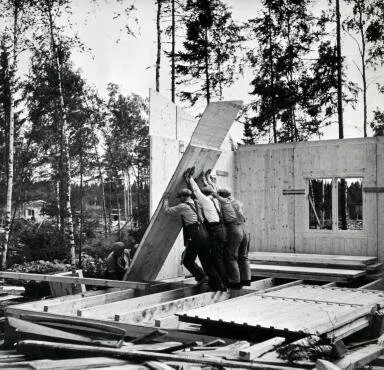
Yet in this new world, there is still work. The people will build houses and live in them, they’ll plant vineyards and eat from them. The people of God will long enjoy the work of their hands, Isaiah tells us. They’ll enjoy the work of their hands.
Imagine that. Imagine what it would be like to enjoy the work of your hands in the world. Imagine what it would be like to do work that you could enjoy forever. Really take a moment to imagine it, because (if Methodists weren’t against gambling) I would bet that if you were thinking of heaven, of whatever good world comes after this one, you wouldn’t imagine work as a part of it.
And yet, work is a fundamental part of who we are as humans. Even in the garden of Eden, as the story of Genesis 2 goes, even before sin and death had entered into the world, humans had work. The man named all the animals, the woman and the man together tended the garden. Genesis 1 tells us that God made humanity to be stewards of the Earth. We have always had things to be doing on this Earth. When Jesus comes to this earth, he didn’t sit around in luxury—he went out and did the work that he needed to do, work of building relationships and restoring people to health and reminding those who were being unjust that, as Isaiah tells us, when the kingdom of God comes, you won’t be able to take what another has built or what another has grown. Throughout the history of the church, we as Christ’s body here on this earth have always had work to do, work that Jesus left us.
Which is maybe what 2 Thessalonians is getting at. I imagine that this passage seems harsh to us today. We think of puritanical laws proclaiming that if you don’t work, you don’t eat, just as the author says here. But we oftentimes forget that many if not all of the letters of the New Testament were written to address specific pastoral problems in specific contexts. The church in Thessalonica had long struggled with whether the day of the Lord had already come, if the end times were already here. Maybe this portion of the letter was written to remind and reassure the Thessalonians who thought that there was no use in trying in this world anymore that there was still good work to be done.
Because we all have things that we can do, regardless of our abilities. You don’t have to be able to bear back-breaking loads in order to contribute to good work. You don’t have to be able to analyze complicated situations or solve differential equations to help think up good solutions to the problems we face. You don’t have to be able to walk or see or hear in order to make beautiful and wonderful things, to think complicated ideas, to offer love to those around you. Thank God, none of us have to be the best and the brightest in order to do good work. All we have to do is show up and bring our best to everything we can do, or at least the best we can do at that moment. God made us all, each and everyone of us, with goodness. We are all capable of doing what is good and right without growing weary of it.
And goodness knows it will take each and every one of us with all our varied abilities in order to do the good work, because there’s always more to do. More people to feed, more clothing to give, more housing to build, more water to clean, more people to visit, more diseases to cure, more conflicts to resolve, but also, more discoveries to make, more to learn, more to understand, more to create, more to share. Americans know how to work, so much so that we don’t exactly know how to stop or how to not work. And yet, despite all our work, there’s more that needs doing, so we keep doing.
But Isaiah doesn’t tell us that God desires unending work from us. In whatever world comes after this one, there won’t be diseases to cure or conflicts to resolve. We won’t feel that pressure, financial or otherwise, to work until we can’t work anymore, to wear ourselves out for our job. We’ll be able to take the sabbath rest that we never quite seem to manage in this world. We won’t be wore out in our bones. In whatever world comes after this one, we’ll be whole and complete people, people who get to do what brings them delight and joy forever, because surely God delights when we delight and God rejoices when we rejoice.
Given what we’ve learned from Isaiah, maybe what we should be hoping for in this world, for ourselves and for all around us, is a little bit of the kind of work that we’d like to do forever. Maybe it’s praise, as we did last Sunday, all of us gathered together with voices and instruments making beautiful music. Maybe it’s cooking a delicious meal and sharing it with anyone who can come, as we so often do here. Maybe it’s sitting and talking with someone who has something new to teach you or a new story to share with you. Maybe it’s designing and making something that’s never been seen before. Or maybe it’s wondering whether or not you can ride a bike on the Moon.
Whatever it is for each of us, whatever good work it is that we get to do in this life, we know that we’ll be able to keep doing it in the next. There will always be more to know, more to share, more to explore, more to give, in our lifetimes now but especially in the world to come, in that time when we will be reunited with all that life has separated us from, including our Creator, Redeemer, and Sustainer. We can’t know exactly what the next world will be like, even with prophets giving us glances at it. But we can know God, at least a little bit in this world, and so we know that the next will be good and loving and joyful.
And so friends, as you go throughout this week, I want you to notice all the work that is happening around you. Remind yourself of the labor that went into the things that you see and smell and touch and see and use this week and give thanks for it. Remind yourself of the joy that is in the work that you yourself do and give thanks for it. Keep your eyes out for the difficulties of some of the workers around you and think about how we might relieve it. But most of all, notice the work that feeds your spirit. I am beyond blessed that my job involves writing and listening and planning and singing and speaking and teaching, all of these things that connect me to my God. What work in this life brings a blessing to you?
Because if you can find that work, if you can figure out what makes your spirit sing in this world, well, then you’ve found a little bit of heaven here on earth. And isn’t that what we’re all looking for, after all? Amen.
All text and pictures (unless otherwise attributed) © Jo Schonewolf, 2019. You can view a full archive of our sermons by clicking here.