This sermon was preached at Whittier UMC on Sunday, November 10th, 2019, based on Luke 19:1-10. You can listen to it by clicking below.
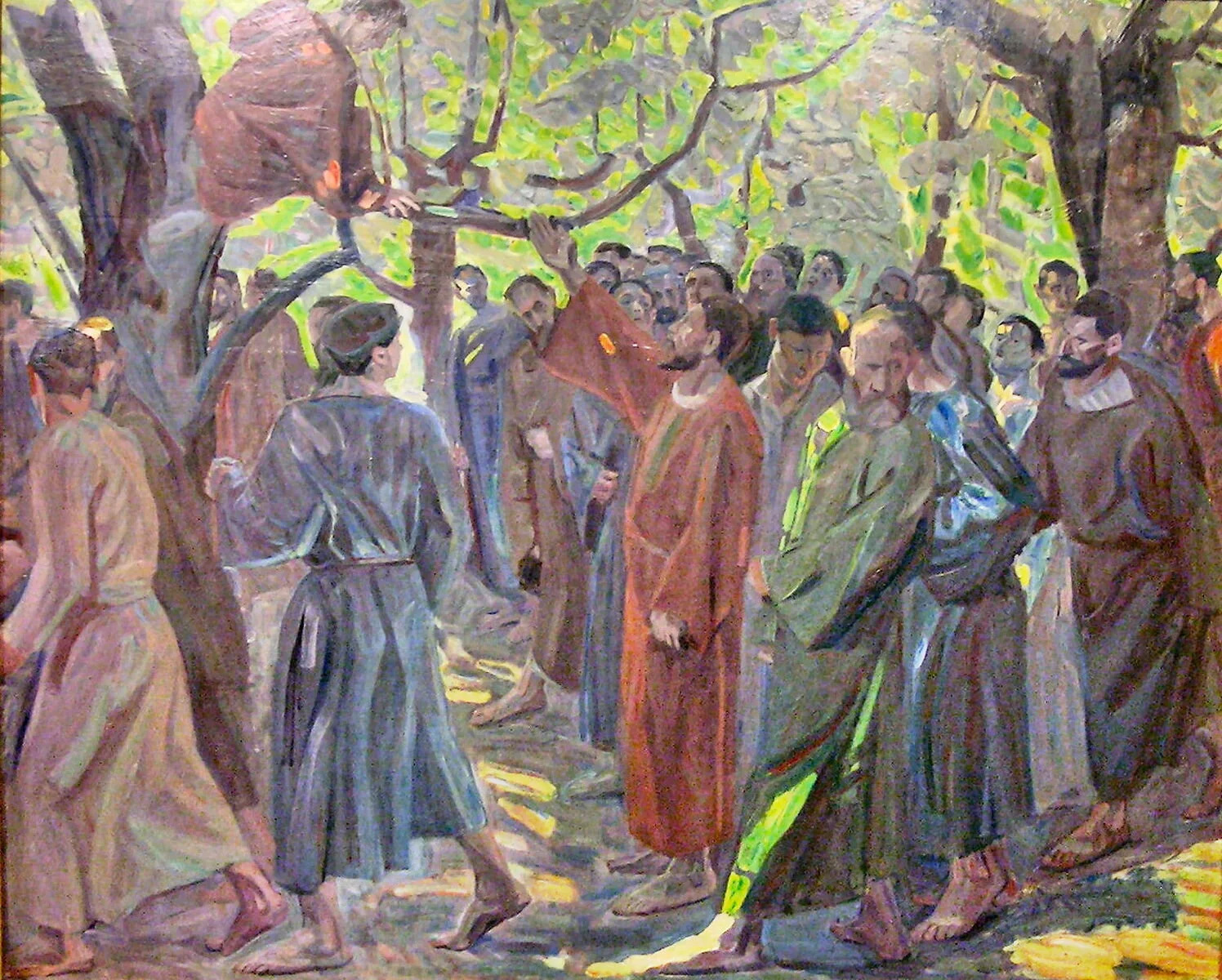
Zakaeus by Niels Larsen Stevns
Would you pray with me?
God of those who are on the inside and God of those who are on the outside, God who sees all without sides, thank you for bringing us to this time and this place. Be with us here today. And may the words of my mouth and the meditations of all our hearts be acceptable to you, our rock and our redeemer. Amen.
This week, I learned that we live in what they call a carbon sink. A carbon sink. This means that we live in an area that’s able to absorb carbon from the atmosphere, the way a drain sucks down the water in your sink (though the “sink” part of carbon sink comes from a different use of the word entirely). Basically, our many trees around here are able to take all of the carbon dioxide in the air, process it, and release oxygen back into the air, sinking the carbon into the ground.
And I’m sure you all know the symbiotic relationship we humans have with trees. We breathe in oxygen and breathe out carbon dioxide. Trees use carbon dioxide, water, and light to make the energy they need to survive, and they release oxygen at the end of the process, at the end of photosynthesis. In essence, we need our trees for oxygen and they need us for carbon dioxide. It’s a win-win. It’s a healthy system. And here in our carbon sink, it’s a more than healthy system. It’s a system that could actually has the capacity to take more in and give more out.
And it’s the idea of a healthy system that I want to focus on this morning. (Sorry to everyone who was hoping these facts about trees was going to lead to some insight about Zacchaeus’ sycamore tree.) See, we’re all involved in systems all the time. We have the system between us and the trees, the system between us and all the nature that we encounter or impact. We have family systems, we have friend systems, we have work systems. At the highest levels, we have systems that describe our interactions with people of varying groups: we have local systems, regional systems, gender systems, racial systems, political systems, trade systems, economic systems, religious systems.
Each and every one of us exists in this world at the intersection of all the systems, all these ways that we relate to others and to the world. It’s impossible to keep track of every one of them (after all, I don’t know how much my carbon dioxide goes into each individual tree, and how much of each tree’s oxygen I breathe in), but it is good to be aware of them. If we have an idea of what systems we’re in, and whether they’re healthy or not, we have a better chance of living the lives that Jesus calls us to live, lives full of abundant joy, grace, love, and peace and lives that share the good news of the gospel and care for the least of these.
And luckily for us, it doesn’t take a degree in order to see the systems at work. It just requires us to pay attention, which brings us to Jesus and Zacchaeus.
Do y’all know that song we sing to our kids about Zacchaeus?
“Zacchaeus was a wee little man
and a wee little man was he.
He climbed up in a sycamore tree
for the Lord he wanted to see.
And as the savior passed that way,
he looked up in that tree
and he said, ZACCHAEUS, YOU COME DOWN,
for I’m going to your house today.”
I think that we often hear about Zacchaeus the way the song describes him: he's a short guy who Jesus choses to eat with and that made him happy. Salvation came to Zacchaeus because he wanted to see Jesus and Jesus saw him.
But the story is so much richer than just what's in the song. There are so many intersecting systems in this story. If we were living when it was written, we'd automatically know the richness that's there, we'd recognize the systems at work, and whether they were healthy or not. We'd know that Jericho was where Herod's summer palace was. If Jerusalem was New York City, Jericho was the Hamptons. This means that in Jericho, there's wealth for a few and poverty for everyone else, all the people serving and supporting the summer palace.
Now, where did all the money come from to keep Herod in such comfort in both Jerusalem and Jericho? Taxes. And who was in charge of taking up those taxes? Zacchaeus. And Zacchaeus wasn't just any old tax collector, like Matthew was; no, Zacchaeus was the chief tax collector. This means that he was in charge of all the other tax collectors and likely took a cut from all that they collected. If you live in Jericho, your taxes, that are in theory due to Rome, are also paying Herod, Zacchaeus, and Zacchaeus' tax collectors, and as I said before, these people were already in poverty. Yet somehow, Zacchaeus was wealthy.
It's no wonder people didn't like him, just based on the economic system alone. Add on to that the fact that he’s a Jewish person who’s helping Rome oppress Jewish people, same as Herod was doing, and it’s pretty clear why people in the city grumbled when Jesus chose to go to Zacchaeus’ house for dinner. There’s both an unhealthy economic system and unhealthy religious system at play here and these systems are creating resentment on all sides. There’s not enough sharing of resources in the first and there’s not enough grace in the second.
Because remember, this crowd that Zacchaeus is excluded from is a crowd of people following Jesus, the same Jesus who, as we read last week, had blessings for the poor and woes for the rich. Jesus’ message about release of the captives and proclaiming the year of the Lord’s favor had a lot of appeal for those without much, those living in poverty, and that’s who followed him, primarily: former fishermen and field hands, those who could barely scrape together a living even before someone like Zacchaeus and his henchmen came around to collect a portion. They’ve heard Jesus’ message and rejoiced because Jesus tells us that God will lift up the lowly and cast down the powerful. If God is truly the God of reversals that we’ve seen throughout Luke, with the lost sheep, with Lazarus and the Rich Man, with the Ten Lepers, with the Beatitudes, then the group gathered around Jesus has every right to think that Jesus will raise them up and cast Zacchaeus down.
After all, hasn’t Jesus spent most of his time on his long journey to Jerusalem, a journey that will end shortly after his visit to Jericho, hasn’t Jesus spent that time knocking down the Pharisees and the Sadducees with his comebacks and his radical theology? Hasn’t Jesus constantly told those in power, those who think they’re better than someone else that the lowliest of this earth will be getting to the kingdom of God ahead of them? Jesus’ famous debates with the Pharisees might actually be what drew Zacchaeus out into this hostile crowd and what drove him up into that tree—the texts tells us that Zacchaeus wants to see who this Jesus is. Maybe he wants to see how he’ll battle the Pharisees and Sadducees of Jericho.
Or maybe he’s heard of Jesus and something has stirred within him, pulling him out to meet this man who might change everything for him. We can figure out plenty about the systems that Zacchaeus was caught in, financially, religiously, politically, and otherwise, but we can’t really ever know his heart.
So Zacchaeus has climbed this tree because he wanted to see Jesus and he was short—the Greek, by the way, is ambiguous here. “He was short” could apply to either Jesus or Zacchaeus. Maybe Zacchaeus was a regular-sized man and had to climb up in a tree in order to see short little Jesus who was hidden by the crowd. In either case, Zacchaeus is up in his sycamore-fig tree and Jesus sees him and knows who he is right away. After all, Zacchaeus is the most hated man in town; at least, he’s the most hated when Herod isn’t there. And he’s likely the only one in the crowd in nice clothes. His reputation proceeds him and Jesus finds him instantly.
And then Jesus has a choice.
Does he ignore him? That might be easiest. Does he say, “Woe to you, Zacchaeus, who lives in comfort while other children of Abraham suffer?” That would certainly get the crowd excited. Does he pause to repeat the parable of Lazarus and the Rich Man? That’s a parable written for Zacchaeus, for sure.
No. Jesus doesn’t do any of these things, any of these things that we would be tempted to do. Give me five minutes with Jeff Bezos, the founder of Amazon, and I’d be deeply tempted to offer him a word of challenge instead of a word of grace. Why does he make billions while his warehouse employees are barely making ends meet, risking their health to keep up with the pace of business that earns him money? I would be sorely tempted indeed, if I met a modern-day Zacchaeus, to cry out, “Woe to you who are rich!”
But Jesus is better than me, as he always is. Maybe he knows something about Zacchaeus’ heart that we don’t, or maybe he was just so pleasantly surprised to see him that he decided to take a chance. “Zacchaeus, hurry and come down for I must stay at your house today!”
And Zacchaeus, miracle of miracles, listens to Jesus and hurries on down the tree! It’s a signal that Jesus’ risk has paid off. Zacchaeus welcomes Jesus, once he’s gotten the leaves out of his hair.
Then the grumbling begins. And it’s not just one or two. It’s not just a couple of people who are bothered by this. It’s everyone who saw it. Everyone hates Zacchaeus. Everyone knows him to be a thief and a traitor. He’s not a forgivable type of sinner, like those tax collectors who were just following orders or the sex workers who were just caught up in circumstances beyond their control; Zacchaeus chose to stay in a job that required him to rob the poor in order to feed himself and his family. And he’s very good at that job. We know that, because he’s rich. It would be impossible for Zacchaeus to change his ways and turn to follow Jesus. Jesus is supposed to hate people like Zacchaeus.
But now Zacchaeus has come down the tree and is standing with Jesus, he stands tall. This translation of the text says, “stood there,” but the gloss of it is that Zacchaeus is standing his ground. He’s making a declaration in spite of the murmuring. “I’m giving it away,” he says to anyone who can hear. “I’m giving away half my possessions to the poor and I’m giving back four times as much as I’ve cheated out of anybody.”
Did you catch what happened there?
Jesus offered unexpected grace, grace that made him unpopular with his followers, and Zacchaeus responds with a proclamation of justice and abundant reparations. Jesus, who could have chosen to fix these broken economic and religious systems by inciting violence against Zacchaeus, by removing the person who was causing harm to others, instead chose to offer him grace. Jesus chose to fix these broken systems by love. And with Jesus’ love shining on him, Zacchaeus reveals to all that he’s giving his wealth away.
It surely surprised the crowd, but it shouldn’t have. Remember, from last week, the blessings and woes were followed by a command to love your enemies. Surely if anyone was an enemy of the people who followed Jesus, it was someone who took their wealth. But here we see Jesus loving this enemy, inviting himself into the life of this enemy, bringing salvation to this enemy. We see Jesus restoring the systems in Jericho back to health. No longer will the poor have to breathe out taxes without being able to breathe in what they need to survive. And as for Zacchaeus, he is no longer a lost son of Abraham. He belongs again in this community that had rejected him for what he had done.
Systems are all around us if we have eyes to see them. Systems between us and the trees, between us and the earth, between us and each other, between us and those who we don’t think are us. The systems might be whole and complete and healthy; they might involve give and take and symbiosis, and they might have room to grow. Or they might be broken and unhealthy, with some in the system flourishing because others are suffering. But I’m here to tell you, friends, based on the example of Jesus, that we cannot maintain healthy systems nor heal broken systems unless we do it with love and grace.
And can you imagine what that might look like? Can you imagine what it might look like if our world had a few more people like Zacchaeus and a few more people like Jesus? A few more people who were willing to change their ways and a few more people willing to accept that change? Imagine if the Sackler family, the ones who own Purdue Pharma and the ones who make money off of oxycontin, imagine if they gave away half of what they own and paid back those they defrauded four times as much. Imagine if the Walton family, who owns Walmart, decided to give half of their almost $200 billion to the poor and doubled their workers’ wages. Imagine the restoration that could happen if the love of Jesus invaded these economic systems.
And money is the simple part! Imagine what would happen if we ourselves offered the love of Christ to those who we don’t think deserve it, just as Jesus did to Zacchaeus. Imagine the relationships we might rebuild. Imagine the connections we might find vital again. Imagine the salvation that might come to all through the healing of division, not through simple forgiveness, but through the healing of wrongs and the acceptance of repentance.
For the Son of Man came to seek out and to save the lost.
My friends, sometimes we are the lost. Sometimes we have strayed and sometimes Jesus calls us back in and it changes everything. But sometimes we are the found and Jesus brings in one who was lost and we don’t know what to do with it. This too changes everything for us.
And so I invite you this week to pay attention to the systems. Notice the exchanges between you and the trees, between you and your friends, between you and your family, between you and the world outside of yourself. Are they healthy systems? Are you Zacchaeus, needing to offer repentance through action? Or are you the crowd, needing to accept the repentance of another? How can the unending love of Jesus restore you and the systems around you this week? What can we do to make every system in our life like us and the trees, each giving and taking and able to absorb a little bit more? How can we make our lives a love sink instead of a carbon sink, a place where we absorb all that needs grace in this world and send out love?
Because if we can do that, if we can make our lives a love sink instead of a carbon sink, then the kingdom of God will truly be among us. If we can we can be forces of restoration instead of destruction, then the world will see Christ in our hearts. If we can pay attention to what’s happening around us and bring life into it instead of death and rejection, we will truly be sharing the Gospel with the world. If we can do that, if we can do these things, then we can be Christ for all the Zacchaeuses stuck up in trees. We can cry, “Come down! Hurry on down! Come to grace! Come to love!”
Amen.
All text and pictures unless otherwise attributed © Jo Schonewolf, 2019. To see a full archive of our sermons, click here.