This sermon was co-preached by Pastor Jo and Ian Urriola at Whittier UMC on Sunday. February 16, 2020, based on John 11:1-45. You can listen to it by clicking below.
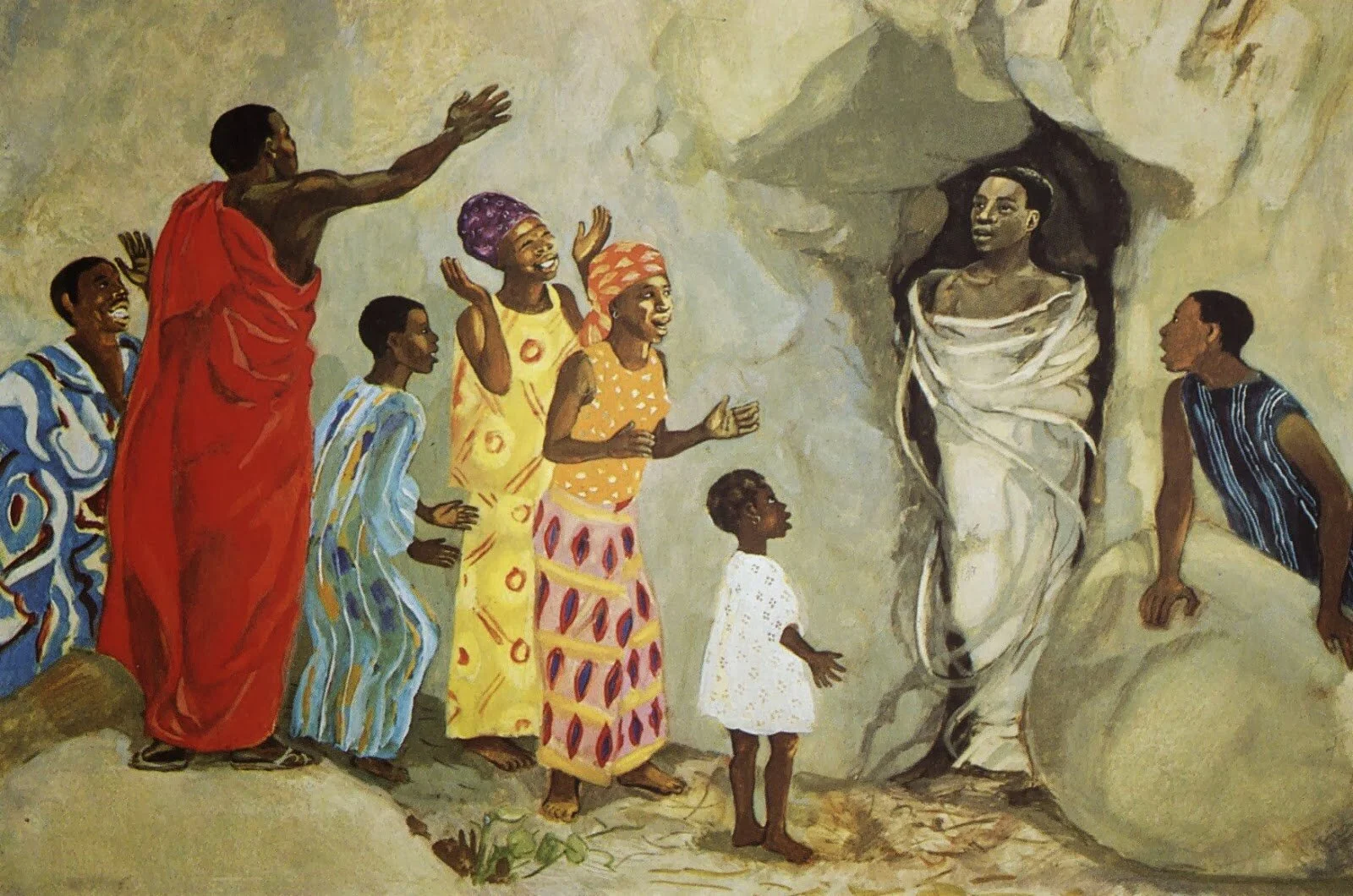
Jesus Raises Lazarus. Jesus MAFA, 1973. Paintings from Photos of Reenactments, Cameroon. Vanderbilt Divinity School Library, Art in the Christian Tradition.
Would you pray with me?
God of wonder and life, thank you for bringing us to this time and place. Be with us here today. And may the words of our mouths and the mediations of all our hearts be acceptable to you, our Rock and our Redeemer. Amen.
Jo: Hey Ian. Do you remember your first experience with death?
Ian: Yeah! It’s actually kinda cute. My great grandpa died when I was little, like 3 or 4, and at the visitation, I went up to the casket, waved, and said, “Bye-bye, Grandpa Great! I hope you have a good time with Jesus!” How about you? Do you remember yours?
J: I honestly don’t. I think it was probably a fish death, though. I had an aquarium but I was not a particularly good fish mom. I remember being upset that my parents made me flush them down the toilet instead of burying them, but I guess in the end, it made sense. There would have been a lot of tiny graves in our backyard if I had.
I do remember the first time someone my age died, though. Sam went to church with me, had grown up in church with all us kids who had been at St. Luke’s since we were in kindergarten. He died in a bike accident while he was on vacation at the beach in the summer before our senior year of high school. One Sunday, he was there in Sunday School, laughing with his friends before the lesson started and listening quietly as the discussion went on, and the next, he was gone and there was nothing anyone could do about it.
I: That’s a difficult story.
J: Many stories about death are.
I: Did losing a classmate like that make you afraid of death?
J: You know, I don’t think so. I think it left me in shock, more than anything else. It was difficult to process the reality of it, the bigness and finality of it, but I wouldn’t use the word afraid.
I: The bigness of it?
J: Yeah. I mean, death is bigger than any of us. To me, when I picture my kind of existential idea of death, it’s a big dark ocean. It’s overwhelming.
I: Hm. You know what this makes me think of?
J: No?
I: It’s something you talk about all the time. It has to do with words like finality, bigness, overwhelming, processing…
J: Awe and wonder?
I: Awe and wonder. By any definition, an experience of death is an experience of awe. Death is something that’s bigger than us, something that’s more powerful than us, and something that is difficult for us to accommodate in our minds. It’s difficult for us to make sense of it.
J: Mm. That’s exactly right. And you know, that helps to explain people’s reaction to death. Most have a natural revulsion to it, which is one possible reaction to an experience of awe, but there are also people who have a kind of morbid curiosity, wanting to learn more about how death works and how we can deal with it, which is another reaction to an experience of awe.
I: Maybe that morbid is kinda engrained in us too.
J: Yeah. I mean, look at Martha in our gospel story. Her brother just died and she and Jesus are over here chatting about what happens after death.
I: Are we reading the same gospel story? Martha’s the one who tells Jesus not to roll back the stone because of the smell.
J: Exactly. She’s fascinated by death.
I: I think you’re over-identifying with Martha here.
J: Maybe. Wait, who do you identify with in this story?
I: Mary! She’s the one who has a real and honest reaction to Lazarus’ death. She’s mourning and she’s upset with Jesus, just like most people would be when someone they love dies.
J: Okay, so we’re doing this. Let’s get into the story. Where do we start?
I: Lazarus is sick. Mary and Martha tell Jesus. Jesus decides not to go to him, and he dies.
J: I mean, it’s also important to think about why Jesus might not go to him right away. Martha, Mary, and Lazarus live in Bethany, right near Jerusalem, close to people who hate him and are trying to kill him and his disciples. And this is some prime disciple content here. Jesus says that brother Lazarus is asleep and it’s time to wake him up, and the disciples say, “Oh, if he’s just sleeping, he’ll be fine. We can stay here.” And Jesus has to explain that no, Lazarus has really died.
I: Listen, we’re all like the disciples sometimes. We miss the point.
J: Sure, sure. But you have to admit that the disciples are dense in this story.
I: Well, there is Thomas.
J: As in Doubting?
I: Yeah, “Doubting Thomas” isn’t so doubtful here. He says, “Let us also go, so that we may die with him.” He knows Jesus is walking into danger by going to Mary and Martha and he’s ready to follow Jesus until the end. And he doesn’t know how right he is. This is the last big story before Jesus arrives in Jerusalem to celebrate the Passover and be crucified.
J: Well, Martha and Mary are also in danger during this time too. Martha’s been tending to house churches in Bethany and Mary’s been off following Jesus during his ministry. They’re clearly an important family in the community—the text tells us that a crowd has come to console them over the death of their brother. They’ve drawn attention to themselves and now they’re asking to Jesus to show up? They must know that this is risky, following a revolutionary fighting the establishment and then asking him to show up at their house after he’s upset the people in charge.
I: It’s Jesus, though. You know that Jesus would want to visit them after Lazarus’ death.
J: Because Lazarus is “the one whom Jesus loved”?
I: Sure. There’s speculation amongst scholars that maybe Lazarus is the person who wrote the gospel of John, or is at least the disciple that Jesus loved. But you also have to believe that Jesus’ heart is grieved by Lazarus’ death.
J: Because of the love thing?
I: No, because Jesus is grieved by all death. And because Jesus loves all of us, every single one.
J: Right, right. That sounds right.
I: And that’s why I identify so much with Mary. Mary believes in the good that Jesus can do. Mary knows that he can save every one of us from destruction. And Mary knows that if Jesus would have come when they called for him, they would have been saved so much suffering.
J: But think about Martha. Mary stays at home, but Martha goes out to meet Jesus. And she says the exact same thing Mary says. “Lord, if you had been here, my brother would not have died.” She’s mourning, just the same as Mary, but in the face of death, she wonders at Jesus and lands on a place of faithfulness. “But even now I know that God will give you whatever you ask.” Martha, even though she wasn’t the one to sit at Jesus’ feet in Luke’s gospel, is the one here who can say that she knows her brother will rise again in the resurrection. She’s the one who’s being faithful, choosing to lean on her faith in Jesus in the face of death. Like the woman at the well, she declares that she believes he is the Messiah, something the disciples still struggle with.
I: So you’re saying that Martha deals with the awe experience of death by being faithful?
J: Kind of. We didn’t get to see Martha right after Lazarus died. We don’t know if her brother’s death overwhelmed her or if she pushed off her emotions in order to deal with all the practical matters of burial. We don’t know if she’s had her time to mourn. But it’s clear that Martha has accommodated death into her understanding of the world, and it’s Jesus that she turns to in order to make sense of it.
I: And what about Mary?
J: What about Mary?
I: How does she accommodate her awe experience of death?
J: What do you think?
I: I don’t think she does. I don’t think she’s able to process it. That’s why she’s in such deep mourning for Lazarus. She can’t make sense of what’s happened and why Jesus didn’t stop it. And how many of us have had that exact same reaction to death? It’s a very human thing to not be able to understand death. Plus, she’s got a whole crowd of mourners with her too, who follow her out when she does go out to see Jesus. Mary is having the natural, normal reaction here.
J: She’ll eventually have to make sense of it, though.
I: Why?
J: Because otherwise she’ll be terrified of death for as long as she lives. It’s the same as any awe experience: either you learn how to think about it, which can in turn lead to curiosity, or you are terrified by it and live in fear of it.
I: That may be. But you know who reacts the same way Mary does?
J: Jesus?
I: Jesus. Jesus, who knew what he was about to do, who knew that this awesome encounter with the power of death was about to be overcome by an even more awesome encounter with the power of life, still wept. No matter how you understand death, whether you know that it’s a part of living or whether you’re afraid of it, whether you think it’s permanent or whether you hope for something more, you still have to mourn a loss. And Jesus knows that. Jesus feels that.
J: Can you imagine being there with Jesus on that day? I mean, try putting yourself there, maybe one of the crowd who came to comfort Mary. It’s dark in the house as everyone mourns, and then a word from Martha comes that Jesus wants to see Mary. You follow her from the dark of the house out into the noonday sun, where she falls at Jesus’ feet. Maybe you can’t hear what they’re saying, but you can tell that Mary is having an impact on Jesus. Jesus, who is usually so unflappable, so sure, looks distressed.
The crowd moves to the tomb and Jesus weeps. Jesus weeps. Jesus, your anchor, your leader, is crying. People around you start murmuring. What’s going on? Is Jesus going to turn to the crowd and preach, to try to make sense of the death of this beloved person?
I: But other people are more cynical. “This man can give sight. He could have stopped Lazarus from dying.” In the crowd, it’s hard to see what Jesus is doing, but a murmur goes up again, because Jesus has asked for the stone to be moved. Martha is talking to him in a low voice, but she’s just saying what everyone else is thinking: Jesus, you can’t go in there. Lazarus has been dead four days. The smell will be unbearable. You can see the people at the front already beginning to pull the tops of their robes over their noses.
And what would Jesus do in the tomb anyway? Mourn by himself? Why subject the entire crowd to the stench of death, just to have your moment with this person you could have saved? The murmuring rises to an aggressive, angry buzz.
J: That all stops when Jesus says to Martha, in a louder voice than before, “Did I not tell you that if you believed, you would see the glory of God?”
I: Then he prays, his face up to the sky.
J: And then he says something that no one expected.
I: Lazarus, come out!
J: And Lazarus comes out.
I: People can’t believe their eyes.
J: The crowd is stunned.
I: But then it erupts with shouts, with questions, with praise, with disbelieving laughter. It’s chaos until Jesus says:
J: Unbind him, and let him go.
I: And someone does. No one really knows who, but within minutes, Lazarus is completely free from the grave.
J: And how does the crowd make sense of this new wonder, this new awesome thing that has happened before their eyes?
I: Many of them believe in Jesus.
J: Just like Martha.
I: Just like Mary.
J: So where does that leave us here today? Jesus isn’t here in flesh and blood to continue to do wonders in front of us. We have these stories, but these stories have been passed down over centuries and centuries and sometimes they lose their impact. How can we connect with Jesus, believe in Jesus, witness about Jesus if we haven’t experienced him?
I: We expect wonder.
J: What?
I: We expect wonder. Jesus isn’t here in the flesh, but God is still working in this world, still doing awesome and powerful things. We have to expect that. We have to look for that. It is our job today to see where God is working, where the Spirit is moving, where people are following Jesus, and marvel at it.
J: Well, and be willing to be part of it too, right? Maybe we’re like the crowd, murmuring about why Jesus hasn’t done this or that, not expecting wonder, but then, when Jesus does work a wonder, we’re so stunned that we forget to take the graveclothes off Lazarus.
I: Right. And that’s really our job as the church, isn’t it? Jesus is the one who brings new life, but it’s our job to remove the things that hold people back in their old lives, the things that have bound people.
J: So maybe you’re a Martha, full of practical answers and faith.
I: Maybe you’re a Mary, abundant in emotions and full of good questions.
J: Or maybe you’re part of the crowd, curious, a little suspicious.
I: But the story of Lazarus tells us that no matter who we are, we are to expect wonder.
J: In the middle of any transition, any loss, any change of any kind, we are to expect wonder.
I: Because that’s what Jesus does.
J: He does wonderful things in us, around us, and through us.
I: And if we learn to expect wonder, and to look for it,
J: we’ll be able to see Jesus,
I: and to join in what he’s doing to bring the dead back to life here and now.
J: So friends, let’s train ourselves to look for wonder. Let’s train ourselves to look for what Jesus is doing and to expect Jesus to do greater things than these.
I: There are plenty of graveclothes to unbind in this world.
J: So let’s get started.
Both: Amen.
All text and pictures, unless otherwise attributed, © Jo Schonewolf, 2020. To view a full archive of our sermons, click here.