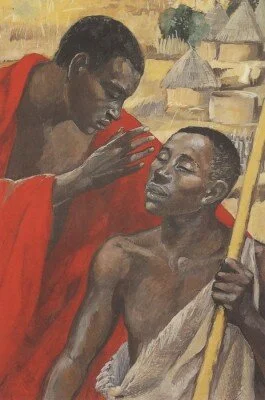
Click here to read John 9, the story of the Man Born Blind.
“Rabbi, who sinned, this man or his parents, that he was born blind?” –John 9:2
The story of the Man Born Blind begins with what I’m sure the disciples thought was an innocent question. “Hey, Jesus, I’ve always wondered about this. How does blindness work? Is it the parents’ fault or the person’s fault?” It’s a curious question, a question that wants to go deeper, wants to grow in knowledge and understanding, a question born out of an abiding faith that all things in the heavens and on the Earth are in God’s hand. Faithful people have asked this question across the centuries: Why do bad things happen? Whose fault is it that sickness and evil exist?
And for once, Jesus doesn’t dodge the question or answer with a parable or a simple image rich with complicated meaning. So often, Jesus gives us something to think about, something to work out for ourselves as we grow as his disciples. Jesus gives us opportunities to be curious about what he’s said, giving us the space to turn a parable or a saying over in our minds until we’ve gleaned wisdom from it. Jesus knows that on our Christian journey, we need to work out our own salvation.
But he doesn’t do that here. He directly contradicts the entire premise of the disciples’ question. Who sinned that this man was born blind? “Neither this man nor his parents sinned,” Jesus says. He does this, I think, because Jesus knows how damaging this theology is, this idea that it’s our mistakes that cause illness. Jesus knows this world—he shaped it, molded it, and came to save it. He knows that sickness comes from living in a fallen world, nothing more. You cannot blame the sick for their illness. As Paul would later say, our enemies aren’t flesh and blood. It’s not our place to attack people with our theology.
It’s hard to express exactly how widespread the theology that Jesus is opposing was in his time, and honestly, in ours. Think of the story of Job: his friends all believe that he must have sinned and sinned horribly to have caused the loss of all his wealth, his family, and his health. That story wasn’t written down to poke fun at a few backward people who believed that sin caused sickness; it was written down because almost everybody believed that sin caused sickness. It was written to counter what we call Wisdom theology, the theology that you see in many of the psalms and proverbs. Choose the way of God and you’ll prosper. Choose any other way, and your world will fall to pieces around you. People get very used to the idea that if someone’s sick or poor or having troubles, it must be their fault. They’ve made their bed and now they have to lay in it.
Jesus doesn’t think that’s true, though. This man wasn’t born blind because of sin, he says. You can’t look at people that way. Instead, look at this situation as an opportunity for God’s love to do its work. Light shines the brightest for us in the darkness. When Jesus was in the world, he was the light of the world. Now, Jesus lives in us. It’s not our place to curse the darkness of our world; it’s our place to see the darkness and let the light of the love of God shine into it.
And sometimes that means getting dirty. Jesus spits into the dirt and spreads mud on the man’s eyes in order to heal him, bringing water and earth together once again to create something new: sight where it had not been before. Then he sends the man to wash away the blindness that the world gave him so that he can receive the sight the Lord gave him.
Shining the light of God’s love can also make people in power angry. The Pharisees continue to condemn Jesus by bringing the man he healed to trial, trying to excommunicate both him and his parents. They question Jesus’ authority to heal, the origin of Jesus’ power, and they end the trial by trying to imprison the man in the theology that Jesus has just set him free from: “You were born entirely in sins.”
After the Man Born Blind has been kicked out of the synagogue, out of the community that he had grown up in, Jesus seeks him out. The Man Born Blind is the only person healed by Jesus who Jesus seeks out afterwards, showing us that shining the light of God’s love isn’t a one-time thing. Sometimes it means standing in solidarity with the rejected, offering on-going comfort and acceptance.
And when we’re doing the work that Jesus calls us to, shining the light of God’s love into the darkness of our world, getting our hands muddy, being unafraid of the consequences of our work, continually offering comfort and affirmation to those in need of it, we begin to see, really see, as Jesus sees, which isn’t the way the world sees. In the end, it’s those who have been trying to exclude, those who are caught up in a damaging way of understanding God and the world, who are blind. It’s not a lack of physical sight that indicates the presence of sin. Sin blocks our spiritual sight.
The disciples asked what they thought was a simple question, expressing some curiosity and seeking an answer, as we all should. Our curiosity and our wonder are God-given gifts and we should use them. But we should also be prepared for the answers to our questions to rock our world, to upend our understanding and to send us out into the world with a new understanding and a new task. That might sound frightening or overwhelming now, but remember, whatever Jesus calls us to do, he will be faithful to walk with us on the journey.
So be courageously curious this week. Ask your deep questions and keep your heart open for the answers that may come, knowing that they might be unexpected. Let Jesus heal you of whatever blindness in your heart so that you can go into this world better able to carry the light of God’s love into the dark places. Amen.
All text and pictures, unless otherwise attributed, © Jo Schonewolf, 2020. To view a full archive of our sermons, click here.