This sermon was preached at Whittier UMC on Sunday, December 22nd, 2019, based on Matthew 1:18-25.
Would you pray with me?
Jesus our Emmanuel, thank you for bringing us to this time and to this place. Be with us again here today. And may the worlds of my mouth and the meditations of all our hearts be acceptable to you, our Rock and our Redeemer. Amen.
Do you ever misjudge situations? I know I do, regularly. For me, it usually involves something I need to move and my ability to move it. Of course I can carry these twelve grocery bags inside in one trip. I can definitely balance all seven worship-planning books in my arms and carry them to the fellowship hall. No, I don’t need any help moving this dresser that is as long as I am tall from my car into my house. I got it.
Nope. I did not have it.
I know that I have an innate tendency to misjudge a situation, usually by being overconfident in my strength and spatial awareness. But I also know that I’m not the only one. One of my favorite stories in astronomy is the discovery of galaxies. We’d been able to see galaxies for millennia, but we called them nebulas (from the Latin for cloud) because to the naked eye and in early telescopes, they looked a little like bits of cloud.
As telescopes got better, though, a fight started between astronomers. In the 1920s, an astronomer named Harlow Shapley made argument after argument about the size of the Milky Way and how it was so massive, it must take up the entire universe. Other astronomers disagreed, including Edwin Hubble, the astronomer that the Hubble telescope is named after. Hubble had to build a new telescope to prove it, but eventually, he identified a certain type of star, called a Cepheid variable star, in other galaxies that allowed him to measure the distance. Cepheid variable stars are like lighthouses, if all lighthouses flashed the same amount of light at the same rate. You can figure out how far away a lighthouse is by measuring how bright the flashes are. In the case of the Cepheids that Hubble found, their flashes told him that they were almost 3 million light years away, much too far to be a part of the Milky Way, which is only about 200,000 light years wide. And so the galaxies were born. (To read more about Shapley and the debate, click here.)
Shapley had fully misjudged the size of the universe, but he did get a consolation prize out of the discussion. The word galaxy comes from the Greek work γαλα, meaning milk, as in Milky Way. Shapley thought the entire universe was the Milky Way and now we think there may be hundreds of billions of galaxies, hundreds of billions of other milky ways, in our universe.
Still, we humans have a tendency to cosmically misjudge things.
And so it’s no wonder that Joseph misjudged the situation with Mary. After all, if we humans have the ability to misjudge galaxies, we surely have the ability to misjudge relationships. In light of this, maybe Joseph is the most relatable character in this story. Most of us would react how he did.
Think about it. The woman that you plan to be married to your whole life is pregnant and you know it’s not your baby. The logical explanation is that she had sex with another man, and under the law of Moses, a woman’s infidelity is grounds for divorce. For us today, we know that the trust necessary for this relationship is broken and will take tremendous time and effort to build back up. We can imagine, too, that Joseph is confused and emotionally devastated.
Whatever Joseph felt, though, the text tells us that the dominant choice in his decision was his righteousness. Joseph is a righteous man. He is concerned, as he must be, with his honor and the honor of his family. If he were to stay with Mary, he and his family would be dishonored by Mary’s pregnancy in a very real way. He would forever be looked down upon and passed over because of Mary’s infidelity. In the minds of the people of the time (and in the minds of some today), Mary is a fallen woman, a shameful woman, a ruined woman, because she is pregnant outside of marriage. Mary’s shame and betrayal would follow her, Joseph, and their family for the rest of their lives and for generations. There is no honor in a carpenter whose wife sleeps around and there is certainly no honor in the children of that marriage.
Joseph knows this, and he knows the law, and so he decides to dismiss Mary. He decides to make her a window and her child an orphan, leaving them to a life on the streets, because remember, there is no room for an unmarried woman in Mary and Joseph’s world. No one would agree to marry Mary after Joseph dismisses her and her own family certainly wouldn’t take her back. Righteous Joseph makes the choice to abandon Mary to her fate. He decides to do it quietly, sure. He won’t be the one publicly dragging her name through the mud. He won’t be the one to throw the first stone. But Mary will still be left alone, with a baby on the way.
Now, we’ve all been raised on this story. We all know how it turns out in the end. We know what God does. But let’s stay with Mary and Joseph in this moment for just a bit longer, because they don’t know. Let’s stay with Mary, our bold, brave, joy-filled Mary, whose fate is held in Joseph’s hands. With one word, he can change her entire world. She will still bear the savior of her nation, but their life will be an immense struggle. Imagine the fear she must have wrestled with as Joseph made his decision.
And then think about Joseph. Righteous Joseph. Joseph who knows that the baby Mary carries isn’t his, who knows that life with Mary will be infinitely more difficult for him than life without her, who knows that the right thing, the righteous thing is to dismiss her as quietly as he can. If he felt qualms about it, they must not have stuck, because he committed to going through with it. Joseph was willing to cast a pregnant woman out on the street rather than lose his honor, his righteousness.
We know better, of course. We know just how severely Joseph has misjudged the situation, how he has misunderstood the amazing length and width and depth of the righteousness of the God he is trying to follow, how profound his misunderstanding is. We know, because we know what happens next.
But how often is the church like Joseph before the dream. How often does the church think it understands what righteousness is and chooses to follow that understanding. How often do it exclude others, allow harm to come to others, because our righteousness demands it. How often does the church misjudge a situation because it misunderstands the depth of what God is calling us to.
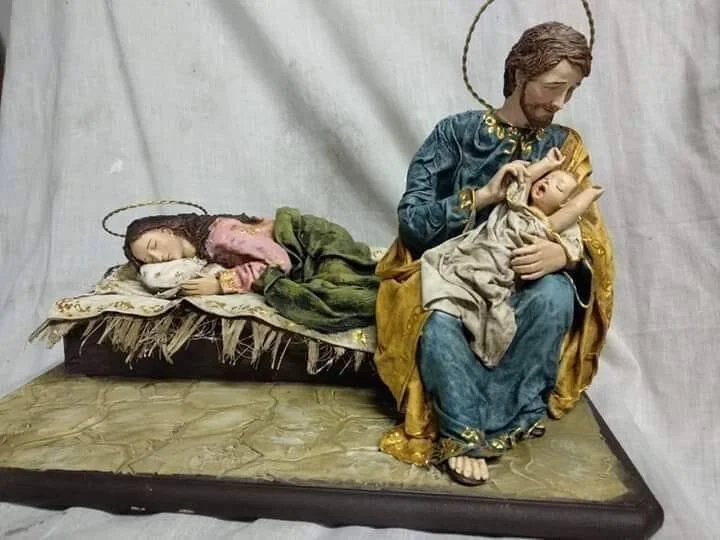
Luckily for Joseph, he dreams, just as another Joseph millennia ago dreamed in Egypt and saved his people from famine. In the dream, an angel of the Lord tells him not to be afraid to have Mary as his wife. The baby in her is from the wind of God, the breath of God, the same that was breathed into the first human formed out of clay. The baby is from the Holy Spirit and the son will save the people from their sins and so the angel tells Joseph to name the baby Yeshua, Jesus, the one who saves.
And this baby, Jesus, this baby is the fulfillment of a long-ago promise, a promise that God has always been fulfilling in Israel. Jesus is the one who saves, just as God has again and again saved Israel and Jesus is Emmanuel, God-with-us, just as God has always promised to be with Israel.
Notice that the angel doesn’t declare to Joseph that all his problems are solved. His honor and his family’s honor will still be damaged by the rumors about Mary. Mary will still have to deal with these rumors for the rest of her days. But Joseph and Mary don’t have to be afraid because they will have God with them, God in the form of baby who will grow in wisdom and stature and free us all from the fears and misjudgments that bind us.
And once Joseph is in, he’s all in. Joseph himself grows in righteousness, grows to understand that God is calling him to more than he had understood. He takes Mary as his wife and he names her son Jesus. Later, after the wisemen come and after Herod decrees the murder of all the baby boys in Judea, Joseph follows another dream to Egypt, making his family refugees, immigrants, in order to take care of them. Here again is Joseph the righteous man whose definition of righteousness expands once more, fleeing his home in order to live as a stranger, depending on the help of others.
It’s this Joseph that we remember, in the end. This Joseph who has lived with Emmanuel, this Joseph who has learned that righteousness is a dynamic trust in God, this Joseph who with Mary raises Jesus, who takes on the difficult job of being a father to the Son of the Most High. We remember Joseph the dreamer, who lets God guide him so that God can better guide the world. Joseph the dreamer who is finally a match for Mary, his wife.
Church, how can we be like Joseph in this season and throughout our lives? Or maybe the better question is how can we learn from Joseph’s story, since angels in dreams are in shorter supply these days?
Well, I think the first thing we learn is that our idea of righteousness is not necessarily the same as God’s. I think the second thing we learn is that anytime our righteousness requires us to harm someone else, we need to think again. And I think, thirdly, that we learn to be dreamers who trust God. We learn to listen to the Spirit, the one who brought Emmanuel into this world and the one who keeps Emmanuel with us today. We learn to keep our eyes and our hearts open for where God is leading us, even if it means giving up something important to us, even if it means taking a chance on a situation that you best judgement tells us is a mistake.
After all, there was only one galaxy in the universe until the day we learned how to see more. Billions and billions more.
And so, as we prepare our hearts for Christmas, let us live lives filled with the fierce joy of Mary and the trusting dreaming of Joseph, because it is in the moments where we discover new depths of love that Emmanuel is born in our hearts anew. May the Spirit that planted the seed of salvation in Mary’s womb and in Joseph’s mind be with us now and always. Amen.
All text and pictures (unless otherwise attributed) © Jo Schonewolf, 2019. To view a full archive of our sermons, click here.