This sermon was preached at Whittier UMC on Sunday. December 29, 2019 based on Hebrews 2:10-18 and Matthew 2:13-23. You can listen to it by clicking below.
Would you pray with me?
God of weeping and God of joy, thank you for bringing us to this time and this place. Be with us here today. And may the words of my mouth and the meditations of all our hearts be acceptable to you, our Rock and our Redeemer. Amen.
I am pleased to report that I have survived my first Advent and Christmas as a fulltime pastor. I’ve been told it’s quite the accomplishment. And between the planning and the travel and balancing work and family and my sanity, I believe it. But even in the midst of the all of the hustle and bustle of the season, there’s some peace and joy to be found this time of year, amen?
Throughout this season, though, I keep thinking about my friend Steve, who lost his father a week before Christmas, and my friend Sarah, who lost hers a few months ago and has been bearing the weight of grief ever since. I mean, Christ is born! As Hebrews tells us, the power of death is defeated! We don’t have to fear it anymore! And yet, the grief and loss that come with a death are just as real as they were before Jesus was born.
I’ve heard it said that grief is just love without anywhere to go, and I think that might be true. Grief is a part of love in this world. And so, I’ve been thinking about the tension my friends must have been feeling this Christmas, how would they would have raised their candles and sang, “Joy to the world!” when part of their joy in this world was gone.
It’s an uncomfortable tension, a tension that, if left untended, could lead to deep anger. Because in a way, it feels like abandonment, an abandonment that we can’t make sense of. How can it be that Jesus is here, that Jesus has freed us from the fear of death, and yet we still have to live with grief, with suffering? The tension between the freedom and joy of Christmas and the grief and pain of our lives in this season can be enough to drive somebody from church, especially if that grief is deep.
And that’s why I’m actually thankful for passages like this morning’s gospel passage. I know it sounds strange, because this passage is about Herod slaughtering all of the young boys in Bethlehem, and it’s not one that we really read when it comes up in the lectionary; we read a psalm or we skip the Bible altogether on this Sunday. But the Church throughout the centuries has known that we need to hear this passage. It’s read it so often that it has its own name: the Massacre of the Innocents.
As horrifying as this massacre is, I’m thankful that it’s in scripture. The grief in this passage is deep. It’s deeper than we want to look at. But it’s not deeper than we’ve experienced. It’s necessary that we look at the grief and at the pain and the trauma and the suffering in this passage.
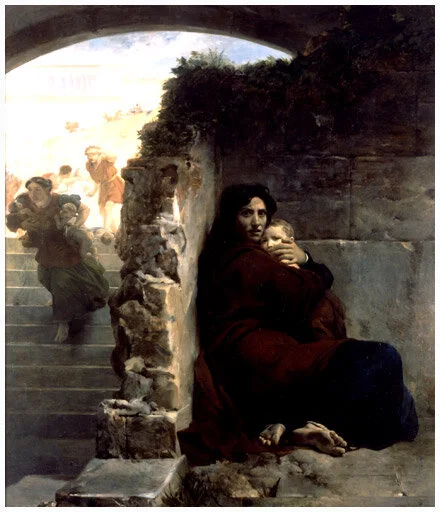
Le Massacre des Innocents by Léon Cogniet
This is a painting called the Massacre of the Innocents, and in it, you can see one mother trying to protect her child while another mother is running with her babies away from the soldiers who are trying to kill them.
Steve Garnaas-Holmes, who writes the Unfolding Light reflections, wrote a poem about this passage, focused on this image. It’s called “Rachel.”
Every year, politely aghast,
we push you aside, Rachel,
firmly usher you off stage
away from the baby
asleep in the manger,
no crying he makes,
so you don't wake him
with your wailing.
Again this year you aren't invited
to our pageant.
Let us come and kneel instead
at your cradle—empty—
your wanting lap,
and behold your devastation:
at the prison doors,
the border walls, the tent cities.
For once let's abandon our denial
that you are the reason he came,
not our comfort and joy,
that our violence is the manger
into which he empties himself,
your grief the abyss he willingly enters.
Your cry is his voice.
With you we shove him offstage,
and our complicity—
until we confess
we have ravaged the manger;
this is Good Friday,
and he does not bear his cross alone.
For you, Rachel,
and your children,
we still our confident carols,
hold silence,
and let your lamentation
be the song of our angels.
When we come across this passage, we have to still our carols. We have to sit at the foot of Rachel’s cradle, which is empty. The pain of this passage, as all pain, demands to be felt. Grief demands to be felt. And even though the light of the world has entered into our darkness and made it right, we all know that there is still pain in this world. There are still tragedies. There are still massacres. The worst imaginable thing can still happen, because the healing of humanity is not a one-and-done process.
The verse that Matthew quotes in this story, the middle of the prophecies that Matthew cites as being fulfilled by this story, comes from the prophet Jeremiah, in the middle of a vision about the joyful return of the exiles from exile. Jeremiah, as we know, is the weeping prophet. He spends most of his prophecies warning about the Babylonian Exile, but every once in a while, he gives us a glimmer of hope. He spends much of chapter 31 talking about how God has loved Israel with an everlasting love and will gather the people back to Israel, sons and daughters, from far away, so that they can live restored in the land of their inheritance.
And yet, in the middle of all this joy, we heard that a cry goes out in Ramah, Rachel weeping for her children because they are no more. Rachel here is a stand-in for all the mothers in Israel who have lost their children to Babylon, to the violence of the exile. Those children are gone and they’re never coming back. Their futures, their hopes, their dreams, their inheritance, it’s all gone. A generation was left in tatters after the Exile, just as Herod tore Jesus’ generation to shreds in his massacre. And the mothers who have lost their children will still weep and wail even in restored Israel.
Healing is not a one-and-done process.
Even with the nation restored and back in right relationship and covenant with God, there are still those who need to mourn what they lost in that process. The savior of the world can be born at Christmas. God can come and dwell among us and still, there is pain that demands to be felt.
And I’m grateful that the Bible recognizes that. I’m grateful that our sacred texts don’t say, “God has already fixed everything, the world is fixed, and whatever happened to you doesn’t matter anymore, so just get over it.” That’s not what the Bible tells us.
We’ve all had those healing journeys in our lives that took some time, haven’t we? You wake up the morning after the end of a relationship and you think that you are well and truly over it, but later that day, you find yourself falling to pieces over a photo or a memory. You lose a loved one and even years later, their favorite song can bring tears to your eyes. You can make it six weeks sober, thinking that this time it’ll stick, and then you relapse. We are complicated people living in a complicated world. Healing can happen in fits and starts. Healing can be a journey with twists and turns, with mountains and valleys and U-turns. Israel can be restored but Rachel still needs to mourn.
And in a way, that’s why we need the incarnation. That’s why we need Jesus to be born into this world, to be God-with-us, Immanuel, to be with us in our suffering, because our healing is a complicated thing. There’s not a miracle cure that will work for every sinner and for every wrong in the organizations and societies built by sinners. But when Jesus entered into our world and into our suffering, as Hebrews tells us, we are made kin of the Most High. We become a part of Jesus’ inheritance. We are reunited with God in a way we hadn’t been before. Heaven and earth are brought together in Jesus so that we might once again know what Heaven is like, what the unending love of God for us is really like.
We get a taste of heaven every time we meet Jesus, whether it’s in a powerful feeling of Jesus being with us, or in the words of a Bible study, or in the singing of a hymn, or receiving of communion, or reveling in nature, or being held in the arms of another who, in that moment, is being the hands and feet of Jesus for us. In all of these moments and in other moments, we get a taste of heaven and a glimmer of what it’s like to be healed from all that ails our spirits as we live in this world of grief. But each of us needs healing in a different way. Each of us has endured different pain and carries these wounds and scars differently and heals differently. It’s not a linear process.
But because Jesus entered into our world, because Jesus has suffered as we suffer, Jesus can walk this healing journey with us. Through the Holy Spirit, Jesus encourages us and guides us as we go through the suffering of this world, even as Jesus works to heal us. Even in our weeping and our wailing, even in our grief and pain, when it comes, Jesus is with us. We are never alone and we are never abandoned, even when we feel like it.
And if we let Jesus walk with us, if we let ourselves go on this journey of healing, no matter how many twists and turns it can take, then we are able to be Jesus for other people. We too can enter into the suffering of this world and be instruments of Christ’s healing in God’s great plan of salvation for all of us. We can do what the Reverend Doctor Howard Thurman calls The Work of Christmas:
When the song of the angels is stilled,
When the star in the sky is gone,
When the kings and princes are home,
When the shepherds are back with their flocks,
The work of Christmas begins:
To find the lost,
To heal the broken,
To feed the hungry,
To release the prisoner,
To rebuild the nations,
To bring peace among the people,
To make music in the heart.
In this life, there will always be Rachels. There will always be Steves and Sarahs mourning losses. There will always be those who live in deep grief for a time, full of love that has nowhere to go. We have to see that pain and acknowledge it and allow it to be felt. We have to understand that the journey of healing isn’t a straight path. But no one has to walk that path alone. We will always have Jesus our Emmanuel to comfort us and guide us and heal us through the Holy Spirit and the church.
And we the church, as we go on our own journeys of healing, can set out with Jesus at our side to do the work of Christmas.
And it’s a joyful work, isn’t it?
Amen.
All text and pictures, unless otherwise attributed, © Jo Schonewolf, 2019. To view a full archive of our sermons, click here.