This sermon was preached at Whittier UMC on Sunday. January 26, 2020, based on John 3:1-17. You can listen to it by clicking below.
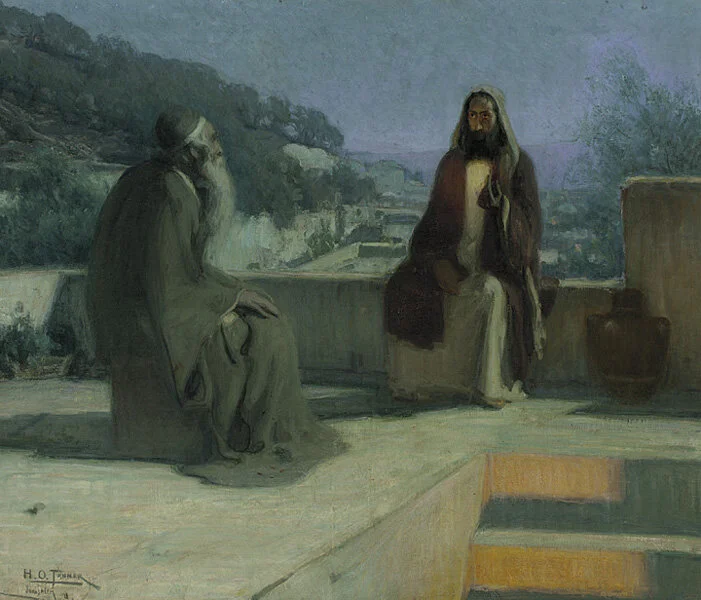
Jesus and Nicodemus by Henry Oscar Tanner
Would you pray with me?
God who is our light in the darkness, thank you for bringing us to this time and this place. Be with us here today. And may the words of my mouth and the meditations of all our hearts be acceptable to you, our Rock and our Redeemer. Amen.
Preaching is hard. I don’t mean to complain about it, it’s one of my favorite parts of my job, but it’s hard. It’s difficult to read a passage and draw meaning from it and try to find just the right way to say or explain what God is speaking to us here in this time through these ancient, holy words. But also, just saying the words is hard. I usually preach from a manuscript, meaning that everything I want to say is right in front of me, word by word, but sometimes when I’m struggling to put the pieces of each paragraph together, I’ll preach from an outline. It’s just bullet points, with a few key phrases here or there, and I put the pieces together as I go along. Both ways have their pros and cons and I know the previous generation of preachers were big on bullet points so that they could move around and speak to the people, but for me, using an outline can be perilous, as some of you might have noticed last week when I said that Moses was the one who killed all the Hebrew children as a baby and that Moses went to free the Egyptians from Egypt.
I cringed real hard when I heard that while transcribing the sermon. Well, at least y’all know what I meant. We all know that Moses wasn’t some killing prodigy and we all know that God sent him to save the Hebrews from their slavery in Egypt. But such are the dangers of public speaking without scripted remarks.
And maybe that’s part of what Nicodemus thought when he was talking with Jesus in today’s gospel lesson. “Oh Jesus. You got some of your letters mixed up. Surely you don’t mean born again?” We can read it as the generous question of someone who is genuinely interested in what Jesus has to say but believes that Jesus has had a slip of the tongue. After all, Nicodemus is a prime example of someone doing what we have set out to do in this sermon series: to turn aside when God draws our attention to something, to go investigate it with open hearts and hear what the Lord has to say to us today. Nicodemus has heard about Jesus and he goes to see what he can find out.
Let’s set the scene a little, though. This interaction with Nicodemus is early in John’s gospel, but a lot has happened already. John the Baptist has proclaimed that Jesus is the lamb who takes away the sins of the world, Jesus calls his first disciples, he turns some water into wine, and then he turns over some tables in the temple in Jerusalem. It’s after this display in the temple that Nicodemus, a Pharisee, a teacher and a leader, goes to see Jesus.
As a point of clarification for those who might be confused, in all the other gospels, Jesus goes to Jerusalem once and he flips the tables after his triumphal entry, which we celebrate on Palm Sunday. But in John’s gospel, the timeline is different. Jesus goes to Jerusalem three times for the Passover festival, which is how we get the idea that Jesus’ ministry was three years long. And it’s on the first of these visits in the gospel of John where Jesus turns over the money changers’ tables.
So far, Jesus has met with John the Baptist, called some disciples, done a couple of miracles, and flipped over some tables, and somehow this is enough to pique Nicodemus’ attention. And honestly, I would have done the same if I were in Nicodemus’ shoes. I’m always down for some extra wine and questioning the economics of religious institutions. Truth be told, though, we can’t know Nicodemus’ intent in coming to Jesus. Maybe he was curious, as we’re striving to be, but he comes to Jesus by night, not willing to let his interest be seen. We can be generous to him if we want, but we can’t be sure of what brought him to Jesus.
Because we don’t hear Nicodemus’ response to Jesus’ discussion about being born of the Spirit and about the saving of the world. After Jesus is done talking, the passage jumps to Jesus and John the Baptist, talking about who the Messiah is. We do hear from Nicodemus again in John, though. He’s mentioned three times in this gospel, the only gospel he’s mentioned in. Nicodemus has this conversation with Jesus in chapter 3 and then in chapter 7, when the Pharisees are discussing arresting Jesus, Nicodemus, “who had gone to Jesus before, and who was one of them,” makes the case that Jewish law commands that they give a person a hearing before judging them. The other Pharisees mock him, but they don’t kick him out. Clearly, Nicodemus has some loyalty to Jesus here.
And the last time we read about Nicodemus is after the crucifixion. He again goes to Jesus by night, this time to bury him. He brings 100 pounds of spices, myrrh and aloe, a burial fit for a king, and together he and Joseph of Arimathea take Jesus from the cross and to the tomb.
I am fascinated by Nicodemus, this man who wants to hear from Jesus but doesn’t want to lose his position over it, this man who defends Jesus verbally but won’t commit to following him, this man who gives a royal burial for our Lord, but who is only ever seen with Jesus by night. Nicodemus is curious but cautious and, in the end, helps Jesus in the only way he thinks he can: by laying him in a new tomb and closing it with a heavy stone.
So let’s follow Nicodemus’ conversation with Jesus with interest and with carefulness, just as Nicodemus follows Jesus. It begins with Nicodemus affirming who he knows Jesus to be: a teacher who has come from God and who has been doing signs through the presence of God. Nicodemus knows that God is with Jesus, at least.
And Jesus affirms that assertion. When we see “Very truly,” in our English bibles, the Greek is actually, “Amen amen,” which is a mark of agreement, a “May it be so” or “I believe this too.” It can also be a kind of self-affirmation, which is where we get this, “very truly,” translation. But I like to read it as, “amen amen,” each time I see it, to remind myself of the positiveness of the phrase. We can imagine Nicodemus and Jesus sitting at a table, having this discussion by lantern light. Nicodemus leans his arms on the table, trying to gain Jesus’ trust (since Nicodemus is, after all, a Pharisee), and Jesus responds by leaning in too, with enthusiasm. “Amen amen! I tell you, no one can see the kingdom of God without being born from above!”
Now, that’s a funny thing for Jesus to say. On first glance, it’s an affirmation of what Nicodemus has already said. Jesus has come from God and these signs that he’s doing, they’re signs of the kingdom of God. But this is the only passage in the entirety of John’s gospel where Jesus uses the phrase, “the kingdom of God.” Mark and Luke use it left and right, and Matthew uses “the kingdom of heaven,” because, writing for a good Jewish audience, he wouldn’t use the name of God in writing. But John doesn’t talk about the kingdom like the other gospels do. He talks about his father’s house having many rooms, he talks about bringing in sheep from other pastures, he talks about vines and branches, he talks about bread and water and life. After this passage, John will drop this kingdom language altogether, so let’s see what he does with it here.
Amen amen, no one can see the kingdom of God without being born from above. Now, we’re used to hearing about being born again and that’s a fair translation of the Greek. The word that gets translated “above” here is ἄνωθεν (ah-NO-thehn) and it can mean both “from above” and anew or again. We can understand how it might have that double meaning. Think about the rain as it comes from the skies in the spring, causing the earth bloom again or anew. The word has this sense that when things come from above, they bring newness, new beginnings.
And here’s where the misunderstanding comes in. Jesus has just leaned in to affirm Nicodemus in his belief that Jesus has come from above and we can picture Nicodemus leaning back and laughing good-naturedly in response. “How can anyone be born after having grown old? Can you enter a second time into you mother’s womb and be born?”
We could read this as dismissive, sure, or a boneheaded question, but maybe Nicodemus, as we said before, was just making sure he heard Jesus right. “Surely you don’t mean ‘born again,’ Jesus. We all know that can’t happen.” But there’s another option too. Rabbis, when they get together and discuss things, will often take the most obvious reading of what someone else has said and discount it, so that they can jump ahead to the deeper meaning. Nicodemus and Jesus are having a verbal, theological sparring match and Nicodemus, by saying what he says, is asking Jesus to go deeper. Nicodemus feels like he’s ready.
Because remember, Jesus affirmed him with his amen amen. Jesus said, yes, I am from above and only those who have been born from above can see that, effectively telling Nicodemus that he’s already part of this movement that is growing around Jesus, because Nicodemus can see that Jesus is from above. Nicodemus feels comfortable, welcomed, and is ready to hear more.
So Jesus give him more. “Amen amen,” he says, agreeing that you can’t be physically born again, but also that, “No one can enter the kingdom of God without being born of water and Spirit. What is born of the flesh is flesh and what is born of the Spirit is spirit. Do not be astonished when I tell you, ‘You must be born from above.’ The wind blows where it chooses, and you hear the sound of it, but you do not know where it comes from or where it goes. So it is with everyone who is born of the Spirit.”
Jesus, what? First you’re talking about seeing the kingdom of God, but now you’re talking about entering it? And you’re talking about wind and spirit, which are the same word in the Greek, πνεῦμα. First it’s puns about being born again or from above and now it’s puns about spirit and wind? What are you saying Jesus? We’ll hear the sound of the Spirit but not know where it’s going? How does all of this work? “How can these things be?” Nicodemus asks, astonished.
And now Jesus knows the sparring match is over. He’s overwhelmed Nicodemus, just as learning from Jesus overwhelms each of us sometimes, and so he teases him. “Nic, buddy, you’re a teacher of Israel and this doesn’t all seem clear to you?” I know that we’re reading between the lines to get this humor and camaraderie out of this exchange, but there’s no reason not to. Given the number of puns in the Greek, they’ve joking with each other since the beginning.
“Amen amen,” Jesus begins again. “We speak of what we know and what we’ve seen, but you Pharisees don’t hear us. And if we’ve been talking about earthly things, like those money changers in the temple, and y’all can’t hear us about that, what makes us think that y’all will understand us when we talk about heavenly things? Listen, no one here knows heaven like the person who came from heaven, and let me tell you, just like Moses lifted the serpent in the desert to heal the Israelite’s plague, the one who came from heaven, the Son of Man, will be lifted up, so that whoever believes him may have eternal life.”
And here the Greek gets us once again. ζωὴν αἰώνιον (zoh-ehn ai-ON-ion), life eternal. It’s here that Jesus switched from talking about the kingdom of God to talking about life eternal, or life abundant, or just life, the words he’ll use for the rest of the gospel to talk about what salvation means. But that word αἰώνιον, it doesn’t mean eternal in the way we understand eternity today. We think of eternity as the time that comes after time stops, or time outside of time, or time that goes on forever, but none of that is really in the Hebrew idea of time that Jesus and Nicodemus would be working with. The straightforward translation of αἰώνιον is not eternal, per se, but age-long, for the ages. And there’s two ages that Nicodemus and Jesus would have in mind: the age we’re in now and God’s age, the age when all of earth will again be in harmony with God. When Jesus, or even Paul or any of the other new testament writers, talks about life eternal, this is what he means. Age-long life. Life for the age of God.
We can see how this language takes over from the kingdom of God language. The kingdom of God is the reign of God, when everyone who is in the kingdom of God will live the way God always wanted us to live, in peace and abundance and joy. Believing in Jesus is what gives us that life, the chance to live that life. Nothing saying that you have to die to get it. In fact, it’s just the opposite. You have to be born into it. And then, as the Spirit blows, though we don’t know where it comes from or where it goes, we’ll be able to hear it, and follow it into life for the age of God.
Because it is in this way that God loved the world: God gave God’s only begotten Son so that everyone who believes in him may not be destroyed by this world but have life, real life, life abundant, life fit for the age of God.
Indeed, God didn’t send God’s Son to the world to judge the world, but to save it. Because, honestly, the judgement is already clear: If you believe in Jesus, if you see the world as he sees it, if you have, through him, begun to hear the comings and goings of the Spirit, then you already get it. You see the things in this world that are not of God and you do not do them. But if you don’t believe what Jesus has to say, then you’ve already missed it. This is the judgement, that the light has come into the world and the people loved darkness rather than light because their deeds were evil. You only hide in the dark if you think your deeds are evil, Nicodemus. All those who know what is true, they don’t mind a little light shining on what they do.
Can you imagine being Nicodemus, after Jesus said all that? He wanted to hear this new rabbi talk, to see if he was real deal, as Nicodemus thought he was, and Nicodemus realizes that this is something bigger than a new teacher or revolutionary or healer. This man is from God and he is talking about saving the world, saving it from the darkness that has shrouded it, so that it might once again see in itself the goodness that God created it for. It is all so much bigger than anything Nicodemus imagined. Jesus isn’t here for Jerusalem or for Palestine or for Jewish people flung to distant lands. Jesus is here for the world.
And yet, Nicodemus hears all this and never fully joins this movement of salvation, staying in his position rather than leaving it all behind and following Jesus. The first person to hear John 3:16 went back to his job and stayed quiet. An evangelist Nicodemus was not. Then again, he did carry Jesus to the tomb.
Maybe this has all been Greek to you. Like I said, preaching is hard and it’s difficult to get across the message you want. But I think the story of Nicodemus invites us to expand our expectations of Jesus. I think being curious about this sparring match between two scholars of the law and the prophets asks us to see what Jesus saw, even while being just as confused as Nicodemus was. Maybe Moses did save the Egyptians, in the end. He freed them from having to depend on slavery, to find a more just way of accomplishing what they wanted to do. Maybe eternal life is life that you can live right here and now, a life of peace and joy and abundance. Maybe judgement is not condemnation but a statement of facts. Maybe we do all love darkness, at least a little, but we all, everyone of us, have the chance to see the light, because Jesus came to save all the world.
My friends, I invite you to be like Nicodemus this week. Sit down across the table from Jesus and ask him what he really means. Whether you’re reading this passage again or listening to other sermons or music, reading other scriptures, praying, or talking to others about God, imagine yourself across from Jesus. Be curious. Listen. Seek to understand. And, if you can, go from your time with Jesus listening to the Spirit, walking in the light.
Amen.
All text and pictures unless otherwise indicated © Jo Schonewolf, 2020. To view a full archive of our sermons, click here.