This sermon was preached at Whittier UMC on Sunday. February 2, 2020, based on John 4:1-42. You can listen to it by clicking below.
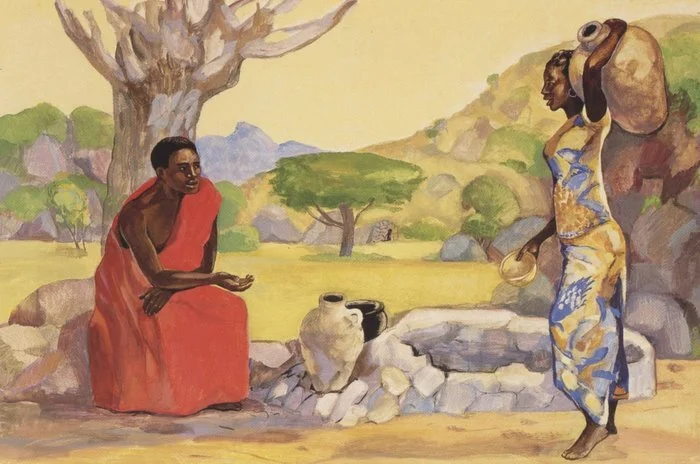
Jesus and the Samaritan Woman by JESUS MAFA, from Art in the Christian Tradition,
a project of the Vanderbilt Divinity Library. For more information, click here.
Would you pray with me?
God who knows us, thank you for bringing us to this time and this place. Be with us here today. And may the words of my mouth and the meditations of all our hearts be acceptable to you, our Rock and our Redeemer. Amen.
Do y’all have a favorite movie, one that you know will hit you right where your feelings live? Steel Magnolias does that for me. Or Fried Green Tomatoes. Or Field of Dreams. Or Rudy. When the whole stadium is chanting and the coach tells him to stay in and he sacks the quarterback and the whole team picks him up on their shoulders? Gets me.
Well, for me, this story from John is up there with Rudy. It hits my emotions right where they live.
Now, we don’t often think of the Bible as an emotional book, or, at least, I didn’t for a long time. Sometimes we think of it as an instruction book, sometimes we think of it as a book of kid’s stories with nice, neat morals at the end, and sometimes we think of it as a book about Jesus, though Jesus himself is kinda… distant.
And honestly, John is sometimes the worst book of the Bible for that. Jesus washes his disciples’ feet and lets Judas go, both powerful stories, but then he starts talking and talking. It takes Jesus four entire chapters of talking and praying, giving instruction and commandments, to go from his last meal with the disciples to being arrested. Guess he was stalling for Judas.
Even here, in this story, Jesus and the Samaritan Woman trade theological jabs. They are sitting out in the noonday sun, arguing over whether Jews or Samaritans worship on the right mountain. At least when he was talking with Nicodemus, Jesus had the sense to have the conversation somewhere where he wouldn’t get a sunburn.
For most of the story, Jesus is Theological Wisdom Jesus or Magician Jesus. First, he has the audacity to come into Samaria and tells a Samaritan woman that he can give her living water so that she’ll never be thirsty again, and she’s like, “Sign me up, magic man! Give me this water so I don’t have to keep coming to this well in the middle of the day!” And then talks her ear off about living water and true worship. Then later, the disciples are all, “Rabbi! Eat!” and Jesus said, “I have food to eat that you do not know about.” And the disciples, bless their hearts, ask each other, “Do you bring him something to eat? Did you? Did someone bring Jesus some secret food without telling the rest of us? Did Jesus make some magic food for himself?” And then Jesus goes on to talk about doing staying saved and doing God’s missions. It really is impossible to get a straight answer out of Jesus in this story, just as it was with Nicodemus.
And yet, despite all that, this story is one of my favorites in the Bible, because of this woman. I find her as fascinating as I find Nicodemus. In fact, in many ways, she is the polar opposite from Nicodemus. She’s a woman, and that’s her first problems as far as this passage is concerned. On top of that, she’s a Samaritan, which explains all the mountain talk.
See, the Samaritans and the Jews had a disagreement going back to at least before the Babylonian Exile, maybe all the way back to the high priest Eli, who was around before King David. Samaritans and Jews share the Pentateuch, the first five books of the Bible, and some of the rest. They share ancestors—they are all children of Abraham, Isaac, and Jacob. But the Samaritans believe that the right place to worship God is on Mount Gerizim, not on the temple mount in Jerusalem. They believe that the right place to worship God is not in Judah but in Samaria, in the far north and west of what is today Israel, a place from which Joshua had conquered Canaan, and here is the root of the disagreement. Jewish people in Jesus’ time believed that the Samaritans were mistaken and would make fun of them; that’s part of what makes the parable of the Good Samaritan so powerful. It’s like… the English telling jokes about the Scots, calling them uneducated and making fun of their accents. Jewish people in Jesus’ time would have thought of Samaritans as backwards. And yet, it’s the backwards person who does the right thing.
And that’s also the one-two punch of this story. Not only does Jesus talk to this woman, this Samaritan woman, but she is the first person in the gospel of John that he reveals his Messiah-ship to.
And more than that, too. This Samaritan Woman in Samaria, in her homeland, is coming to draw water in the middle of the day, at the hottest time. Why is she doing that?
Because she’s ashamed. She’s been rejected by society. Why?
Because she’s had five husbands. All of the curiosity aimed at her has been harmful, has been a slanderous interest in the object of the town’s gossip.
And so she longs for this living water that Jesus promises, even though she questions him at first. She’d be able to survive without ever having to be rejected again, if she had this living water. She is in need of what Jesus has to offer.
Nicodemus comes to Jesus at night. Nicodemus, a Jewish man of authority and respect, comes to Jesus and asks him theological questions, never really needing Jesus, never spreading the word about Jesus. But this woman, this Samaritan woman with five husbands, rejected by society, encounters Jesus in the middle of the day. She’s the complete opposite of Nicodemus, but she’s still drawn into a theological argument over where the right place to worship is and then Jesus says the pivotal sentence:
“Go, call your husband, and come back.”
Now, we know this woman. We talked about her way back in July or August and we talked about how it’s not necessarily that she’s a harlot, but how she might be a widow five times over or have been unjustly divorced, or some combination of the two. We’ve tried to humanize her, make her worthy in some way of the Savior’s attention because of the hurt in her life. But even if she had run around on all her other husbands, it wouldn’t lessen the impact of what comes next.
She decides to be honest.
“I have no husband.”
And Jesus says, with all the compassion in the world. “I know. You’ve had five. And the one you’re with won’t even take you as his wife.”
Jesus names her pain. He sees her as she is. He knows her. And this changes everything for her. Nicodemus came to Jesus with curiosity, but we’re left with an ambiguous ending for him. Did he believe Jesus? Did he not? Where did the curiosity that Nicodemus had leave him after he interacted with Jesus? But this woman, when Jesus sees her, when he knows her, when he looks at her with loving interest, everything shifts for her.
She still asks him a question about where Jews and Samaritans should worship. Of course she does. This is the main divide between her and Jesus and she wants it to come down. And Jesus says, these mountains don’t matter. When the time comes, we’ll all be able to worship in truth. And I’m here. The time is now.
And this woman, that’s it for her. Jesus has seen her. Jesus knows who she is and Jesus doesn’t shun her. In fact, Jesus brings her into this fellowship for the saving of the world. She runs and tells the town, the town that before now had only looked at her with an exploitative curiosity, the town whore who they could observe and disregard with no consequences. But here is a man who sees her for who she is and promises to gather her in with all his other disciples. Jesus knows her. And Jesus knows that she matters.
And the town, we find out, believes her, believes her so hard that they convince Jesus to stay in Samaria for two more days. And then, the people say, “We believe for ourselves. This man is the savior of the world.”
So what do we have to learn from the woman at the well? Why is her story so powerful? Well, I have two things that I take away from her story.
The first is that curiosity hurts sometimes. Curiosity, when it’s self-serving, hurts. When we want to find out someone else’s pain because we want to be caught up on the gossip, or when we stare at the person who is different from the rest of us, we hurt others with our curiosity. And we all understand that, on some level. None of us want the most secret parts of ourselves on display, for the world to be curious about. And so we, as Christians, have a responsibility to respond to others not with self-serving curiosity but with grace. When someone draws the eye but not in a good way, we have to put ourselves in their shoes, and respond the way we would want others to respond to us if we were them, with kindness and space and hope.
And the second is that sometimes, we need our curiosity awakened within us, especially if we’ve been hurt the way the woman at the well is. We, all of us, have found ourselves caught up in situations of hurt and pain. That hurt and pain is real. We shouldn’t disregard it. But Jesus shows us that if we name the pain, if we acknowledge it and are honest about it, we can find healing. We can find hope. The woman at the well is cagey, questioning, even after Jesus sees her as she is. But once it clicks, once she knows that Jesus loves her and has her best interest at heart, she goes and tells the entire town. Once our curiosity is awakened, it can carry us to do remarkable things.
I’d like to end today’s sermon by reading a poem by Chris Kinsley about the woman at the well, a poem that tells us how to live in Jesus’ compassionate curiosity, a compassionate curiosity that can change lives. It’s called Woman of No Distinction. And it goes like this:
WOMAN OF NO DISTINCTION
By Chris Kinsley
I am a woman of no distinction
of little importance.
I am a woman of no reputation
Save that which is bad.
You whisper as I pass by and cast judgmental glances,
Though you don’t really take the time to look at me,
Or even get to know me.
For to be known is to be loved,
And to be loved is to be known.
Otherwise what’s the point in doing
either one of them in the first place?
I want to be known
I want someone to look at my face
And not just see two eyes,
a nose, a mouth and two ears;
But to see all that I am, and could be
all my hopes, loves and fears.
But that’s too much to hope for,
to wish for,
or pray for
So I don’t, not anymore.
Now I keep to myself
And by that I mean the pain
That keeps me in my own private jail
The pain that’s brought me
Here at midday to this well.
To ask for a drink is no big request
But to ask it of me?
A woman unclean
Ashamed, used and abused
An outcast, a failure
A disappointment, a sinner.
No drink passing from these hands
To your lips could ever be refreshing
Only condemning
As I’m sure you condemn me now
But you don’t.
You’re a man of no distinction;
Though of the utmost importance.
A man with little reputation, at least so far.
You whisper and tell me to my face
What all those glances have been about
And you take the time to really look at me.
But don’t need to get to know me.
For to be known is to be loved and
To be loved is to be known.
And you know me.
You actually know me;
All of me and everything about me.
Every thought inside and hair on top of my head;
Every hurt stored up, every hope, every dread.
My past and my future, all I am and could be.
You tell me everything,
You tell me about me!
And that which is spoken by another
Would bring hate and condemnation.
Coming from you brings love, grace,
Mercy, hope and salvation.
I’ve heard of one to come
Who could save a wretch like me
And here in my presence,
You say, “I am he.”
To be known is to be loved;
And to be loved is to be known.
And I just met you.
But I love you.
I don’t know you,
But I want to get to.
Let me run back to town
This is way too much for just me.
There are others
Brothers, sisters, lovers, haters.
The good and the bad, sinners and saints
Who should hear what you’ve told me;
Who should see what you’ve shown me;
Who should taste what you gave me;
Who should feel how you forgave me.
For to be known is to be loved;
And to be loved is to be known.
And they all need this, too.
We all do
Need it for our own.
Amen.
All text and pictures, unless otherwise attributed, © Jo Schonewolf, 2020. To view a full archive of our sermons, click here.